Wednesday, March 08, 2006

I saw an interesting article that discusses what the Daniel Yankelovich sees as a "great divide" between 'scientists' and 'society.'

While I don't necessarily agree completely with the points he raises solution he recommends, many of his observations are really thought-provoking in the larger context of society (not just with regards to science). Here is a short section from the article that I thought might raise some interesting questions in your minds. Any thoughts?

"Winning Greater Influence for Science"
by Daniel Yankelovich
Issues in Science and Technology
(published by the National Academy of Sciences)
Summer 2003


.....
The unfortunate reality is that scientists and the rest of society operate out of vastly different worldviews, especially in relation to assumptions about what constitutes knowledge and how to deal with it. Scientists share a worldview that presupposes rationality, lawfulness, and orderliness. They believe that answers to most empirical problems are ultimately obtainable if one poses the right questions and approaches them scientifically. They are comfortable with measurement and quantification, and they take the long view. They believe in sharing information, and their orientation is internationalist because they know that discoveries transcend borders.

The nonscientific world of everyday life in the United States marches to a different drummer. Public life is shot through and through with irrationality, discontinuity, and disorder. Decisionmakers rarely have the luxury of waiting for verifiable answers to their questions, and when they do, almost never go to the trouble and cost of developing them. Average Americans are uncomfortable with probabilities, especially in relation to risk assessment, and their time horizon is short. Policymakers are apprehensive about sharing information and are more at home with national interests than with internationalism. Most problems are experienced with an urgency and immediacy that make people impatient for answers; policymakers must deal with issues as they arise and not in terms of their accessibility to rational methods of solution.

This profound difference in worldview manifests itself in a many forms, some superficial, some moderately serious, and some that cry out for urgent attention. Here are three relatively superficial symptoms of the divide:

Semantic misunderstandings about the word "theory." To the public, calling something a "theory" means that it is not supported by tested, proven evidence. Whereas a scientist understands a theory to be a well-grounded explanation for a given phenomenon, the general public understands it as "just a theory," no more valid than any other opinion on the matter. (Evolutionary "theory" and creationist "theory" are, in this sense, both seen as untested and unproven "theories" and therefore enjoy equivalent troth value.)

Media insistence on presenting "both sides." When this confusion over "theory" bumps up against media imperatives, the result is often a distorting effort to tell "both sides" of the story. In practice, this means that even when there is overwhelming consensus in the scientific community (as in the case of global warming), experts all too often find themselves pitted in the media against some contrarian, crank, or shill who is on hand to provide "proper balance" (and verbal fireworks). The resulting arguments actively hinder people's ability to reach sound understanding: Not only do they muddy the public's already shaky grasp of scientific fundamentals, they leave people confused and disoriented.

Science's assumption that scientific illiteracy is the major obstacle. When faced with the gap between science and society, scientists assume that the solution is to make the public more science-literate--to do a better job at science education and so bring nonscientists around to a more scientific mindset. This assumption conveniently absolves science of the need to examine the way in which its own practices contribute to the gap and allows science to maintain its position of intellectual and moral superiority. In addition, on a purely practical level a superficial smattering of scientific knowledge might cause more problems than it solves. Two other manifestations of the divide are less superficial and more serious:

The craving for certainty about risk and threat. The public and policymakers crave a level of certainty that the language and metrics of science cannot provide. For example, when the public is alarmed by something like the anthrax scare or some future act of small-scale biological or chemical terrorism, science will assess the threat in the language of probabilities. But this metric neither, reassures the public nor permits it to make realistic comparisons to other threats, such as nuclear terrorism. Science's frame of reference does not communicate well to the public.

Divergent timetables. The timetables of science (which operates in a framework of decades or longer) are completely out of synch with the timetables of public policy (which operates in a framework of months and years). It has taken nearly 30 years for the National Academy of Sciences to complete its study of the consequences of oil drilling in Alaska's North Slope; in that time, a great deal of environmental damage has been done, and political pressure for further exploration in the Arctic National Wildlife Refuge has gained momentum. At this stage, the academy's scientific report stands to become little more than a political football. Vaccine research is another example: Political demands for prompt action on high-profile diseases do not jibe well with the painstaking process of research and trial. Political pressures push resources toward popular or expedient solutions, not necessarily those with the greatest chance for long-term success.

Two more manifestations of the divide are particularly troublesome:

The accelerating requirement that knowledge be "scientific." In both the academic community and Congress, the assumption is growing that only knowledge verified by scientific means (such as random assignment experiments) can be considered "real knowledge." Unfortunately, only a minuscule number of policy decisions can ever hope to be based on verified scientific knowledge. Most public policy decisions must rely on ways of knowing--including judgment, insight, experience, history, scholarship, and analogies--that do not meet the gold standard of scientific verification. Our society lacks a clear understanding of the strengths and limitations of nonscientific ways of knowing, how to discriminate among them, and how they are best used in conjunction with scientific knowledge. Since the time of the ancient Greeks, our civilization has presupposed a hierarchy of knowledge, but never before have forms of nonscientific knowledge been so problematic and devalued, even though they remain the mainstay of policy and of everyday life.

Colliding political and scientific realities. Although the scientific framework demands that scientists maintain objectivity and neutrality, political leaders pressure scientists to produce the "correct" answers from a political point of view. When political and scientific imperatives collide, science is usually the loser. President Reagan's science advisors on antiballistic missile systems found themselves marginalized when they didn't produce the answers the administration wanted. Scientists do not have a lot of experience in dealing with political pressures in a way that permits them to maintain both their integrity and their influence. Arguably, this has been the greatest single factor in science's declining influence in policy decisions.

Nor are these the only symptoms. A host of other elements exacerbate the divide between the two worlds: unresolved collisions with religious beliefs, difficulty in assessing the relative importance of threats, the growing number and complexity of issues, and the wide array of cultural and political differences in society.
.....

Friday, March 03, 2006

Whoever said that history is dull?

Read about the Great Molasses Flood of 1919

Thursday, February 16, 2006

This came out in The New York Times a year or two ago but it's amazing how true it still is....


Decoding the Bureau


by Andy Borowitz


From: Director, CIA
To: All CIA Employees

In the weeks and months ahead, some of you may find yourselves talking to FBI employees for the first time. To prevent possible errors in communication, here is a guide to common FBI phrases, complete with their English-language translations:

FBI: We have noticed "increased chatter" in recent weeks.
Translation: We've been intercepting conversations that could be useful if someone here knew Arabic.

FBI: We are making technological improvements at headquarters.
Translation: We now have call-waiting.

FBI: We are committed to making real changes in the way we conduct our business.
Translation: Ever since Coleen Rowley started singing to Congress, we've actually had to read the junk we used to leave in our In-Boxes.

FBI: Here is a list of suspects for you to track.
Translation: This ought to keep you busy while we look for the suspects on the real list, which is safe in our files.

FBI: I am studying the document you shared with me.
Translation: I've been trying to open your e-mail attachment for two days. Are you guys on PCs or MACs?

FBI: We both have the same goal.
Translation: If we put our heads together, I'll bet we can shift the blame to the Bureau of Labor Statistics and the National Park Service.

FBI: Please get back to me at your earliest convenience.
Translation: There is an excellent chance that you or I will be forced to resign by the end of the day.

FBI: Please share this document on a need-to-know basis only.
Translation: If you leak this one to Time, we'll leak the next one to Newsweek.


You can see more of this kind of thing at Andy Borowitz's website-- The Borowitz Report.


The sad thing about this is that it continues to represent current concerns and would still would work pretty well even if you switched the organizations' names around.

Sunday, February 12, 2006

I was up on Capitol Hill the other day and had a good chuckle at something I saw as I was walking by Dennis Kucinich's office and saw a big framed poster saying the following:

Civilization:
1. Polka
2. Bowling
3. Kielbasa


I'm not sure I'd want this guy as president, but you got to admit that he's got a sense of humor....

Wednesday, February 08, 2006

This is a very good article-- saying things that I've not heard before in the popular press:

Saving the Post Office
As Mail Usage Drops, USPS Faces a Whirlwind of Change


By Margaret Webb Pressler
Washington Post Staff Writer
Sunday, January 15, 2006; F01


There are, in many ways, two U.S. Postal Services.

There is the one that people love to hate, especially after a hike in rates such as last week's two-penny jump. This is the Postal Service that made Mark Tornga, 24, hold his head in disbelief as he walked out of a post office on 14th Street NW at 4:30 one afternoon last week.

"Fifty-two minutes I spent in line -- 52 minutes!" the College Park resident fulminated after sending a certified letter for his employer, a public relations firm.

Then there is the Postal Service that has made huge strides in on-time delivery, runs one of the most impressively automated operations in the world and, for now, is bringing in a huge profit. This is the Postal Service that customers such as Tornga don't see, and, frankly, take for granted -- the one that moves 580 million pieces of mail a day with remarkable speed and accuracy to every address in the nation, six days a week.

The first Postal Service is the one that executives are trying to fix, the one with the bad rap, the one that delivers mail late, the one that drives people crazy with its long lines and sold-out 2-cent stamps.

The other Postal Service is the one they are trying to save.

"Am I optimistic or pessimistic? I'd have to say I'm anxious," said John M. Nolan, who retired last year as deputy postmaster general and now works as a consultant.

The structural problems facing the Postal Service are monumental. Despite a tiny uptick last year, first-class mail volume is slowly but steadily eroding as people pay more bills online, send Evites instead of printed invitations and shoot off e-mails rather than write letters. The agency also is facing massive and escalating personnel costs, especially for health care, even as it has embraced automation and reduced staffing needs. And finally, there is the federal government's attempt to change the structure of Postal Service regulation, an effort that postal officials regard as riddled with problems and with favors to private industry.

"It doesn't give us nearly the flexibility we believe we need," said Tom Day, senior vice president of government relations for the Postal Service.

Without making some hard decisions -- and revisions -- in the near term, Nolan and others say, the Postal Service "is on a crash course with cataclysmic change."

What kind of change and when is unclear. Privatization? Shuttered post offices? Dramatically more expensive mail? Less frequent delivery? It could be any of those things -- or none of them. It just depends on how things go.

And this is when people start thinking about the third Postal Service -- the one that delivers possibility six days a week -- a letter from an old friend, a tax refund or an acceptance from the admissions office. This is the post office that brings us the letter carriers we admire, who avoid dogs and leave footprints in pristine snow. It gives the tiniest towns their own proud postmarks. It's the post office that found you even when the address under your name was so incredibly incorrect it was laughable.

This is the Postal Service that no one wants to lose.

* * *

At its most basic level, the Postal Service needs to keep as many customers as it can, and a good place to start is by tackling its legendary customer-service problems. Although users of many rural and suburban post offices rarely see the kinds of hassles that are routine in urban locations, city dwellers are familiar with the maddening pace of two clerks plodding through a 20-person line.

At these especially busy locations, Day said the agency is trying to keep wait times down by rescheduling staff lunch breaks, once routinely taken during the midday rush, and splitting some shifts in two. Individual postmasters are tracked based on such performance criteria, too, with independently measured wait times at individual offices factored into pay and promotions at the end of every year.

"Unfortunately, we know, looking at the numbers, we do have pockets of problems," Day said. "But the good news is we're aware of it; we do hold people accountable. That's where we really force the issue of restaffing and rescheduling."

With 38,000 retail offices nationwide, this effort is notoriously slow going. That's how, even on the Monday before Christmas -- a day touted in a Postal Service press release as the busiest mail day of the year -- there were only two clerks serving customers at 6 p.m. at one of the District's main post offices, the Friendship branch in Northwest. The line snaked out the door.

Day said that in such circumstances, the branch manager should be out in the lobby, sorting customers' needs in line and helping where possible. On the other hand, managers inclined to do this are somewhat limited in how they can pitch in because, under union rules, they cannot open an empty clerk station and start serving customers.

William Burrus, president of the American Postal Workers Union, said the Postal Service has institutionalized long wait times by cutting staff sizes, following the model of the private-sector retail industry.

"They could provide a two-minute wait max, if they wanted to," Burrus said. "But they don't want to because they know the American public will accept a delay. They've become accustomed to it."

One area where Day and Burrus agree is in the way Americans view postal employees. Surveys show that most of them hold postal workers in high regard. Even Tornga, after his 52-minute wait in line, offered up an unprompted compliment.

"Once you get up there, the people are perfectly nice," he said. "It's just crazy how long it takes."

* * *

In the meantime, postal officials keep coming up with ways to keep people -- happily -- out of the post office.

There are the post office's retail partners, grocers in particular, that sell books of stamps, which has become one of the most common ways people buy stamps.

(Day bristles at the thought that the post office seems to get no credit for such efforts. "It's as though supermarkets dreamed it up all on their own," he said.)

There's the almost-four-year-old Click-N-Ship service: Go online and find out the rates, print the postage at home, then schedule a free pickup.

The problem has been getting out the word that Click-N-Ship even exists, in a world where many small-volume mailers now reflexively call United Parcel Service or FedEx. Day says even his own nephew was using UPS to ship things he sells on eBay.

"There is, in the younger generation, a sense that the Postal Service is out of date, slow and all the rest," he said. "So reaching them and letting them know that we do provide online services that are useful, customer friendly and timely is a challenge."

Computer-generation technology has also reached 2,000 postal offices nationwide in the form of new Automated Postal Centers, which can do many of the things people stand in line for: dispense stamp sheets, sell postage in any denomination, look up rates and Zip codes, provide certified mail receipts, and so on.

"I'm sure my mother would struggle with it, but people who are comfortable with computer technology, after just a few basic tips, they understand how to use it," Day said.

And for the lower-tech among its customers, post offices now give out nifty cardboard scales that measure how much postage you need for a letter.

* * *

To encourage people to use the mail more, the post office has been aggressively advertising some of its newer services on television. It is even getting downright touchy-feely. In another effort borrowed from Madison Avenue, it's giving people what they love: babies and animals.

The Postal Service is in the midst of a second test of PhotoStamps, which let consumers put their own cute pictures on commemorative-size stamps they can order online. It was the brainchild of Stamps.com, which has long had a contract with the Post Office to sell postage online.

"To their credit, they went along with it," said company president and chief executive Ken McBride, who deems the test a success. From May to September, customers bought 3.5 million PhotoStamps, he said, featuring adorable kids, bouncy puppies and romantic moments.

"We believe a lot of this is new revenue," McBride said. "Customers are using PhotoStamps and coming back from electronic means of communication. They're excited about it, so they're sending real invitations rather than electronic invitations, personal letters instead of e-mail."

* * *

Behind the scenes at the Postal Service lie both its best and worst stories.

Since 2000, the agency has gone through an astonishing makeover of automation and efficiency; reducing staffing by 100,000 to just over 700,000, all through attrition; while delivering more mail to more delivery points. Last year, the post office took roughly 212 billion pieces of mail to 144 million addresses, 2 million more delivery points than in 2004.

What postal officials find most gratifying is that on-time delivery has improved, too: Today, 96 percent of mail is delivered on time to the Zip codes that should only take only one day for delivery. Eight years ago, that figure was 92 percent, Day said.

Businesses and other big-volume mailers are bar-coding mail so it can be processed faster and automatically. New optical readers can decipher all but the worst handwriting on envelopes.

And last year was a particularly good year, with mail volume up, and even first-class mail rising one-tenth of a percent. But these results belie an underlying erosion in the most important type of the Postal Service's business.

About two years ago, first-class mail fell below the 50 percent threshold of mail volume for the first time. It now accounts for about 46 percent of all mail, while direct-mail marketing items represent 49 percent. The rest is packages. The package-delivery business is so dominated by UPS and FedEx that the Postal Service now partners with these private carriers along parts of the delivery chain. The theory is that it's cost-effective for both if only one delivery person has to walk up to a house. There are even FedEx boxes in some post offices.

The decline in first-class mail is partly because people are writing fewer letters, but it's also closely tied to the banking industry. The more people pay bills online, the more money banks save, so they're making it easier to do. Financial remittances represent about $17 billion of the Postal Service's $70 billion operating revenue, so it's a big chunk to lose.

"My concern would be . . . there comes a tipping point in the financial services industry where the balance goes so heavily towards electronic means of communication for bills and bill payment that they may get more aggressive in providing incentives to customers to get them out of the mail," Day said.

To deal with the expected decline in revenue, the Postal Service needs to raise money in other ways and cut costs, and that means several looming battles, Day said. Rates will likely rise again for first-class stamps and for direct mail, perhaps as early as next year, he said.

Later this year, the agency will also begin renegotiating contracts with four major unions in hope of winning concessions on some high-cost benefits such as health care. Union leaders are ready for a fierce fight.

"The employees that I represent, they should be rewarded for a job well done," Burrus said. "All of the savings [the Postal Service has] achieved came on the backs of the employees I represent."

And the Postal Service faces an even bigger battle with Congress, which is considering reforms that would change some of the service's legal requirements and create a new oversight body. But critics of the legislation are everywhere, and bills in the House and Senate are stalled.

"Everyone who wants something to be done throws in their oar at the 11th hour," said Nolan, the former deputy postmaster general, leaving the bills full of favors to private industry and regulations that will hamstring postal officials. "If you wanted to design bad legislation, this is it."

But there are critics of the Postal Service who like the idea of more regulation, if only because it would create more accountability for its failures.

"There is realistically no one that can force the Postal Service to do anything," said Rick Merritt, executive director of PostalWatch, a nonprofit watchdog group. "The Postal Service does not get appropriations from Congress, so one huge lever in the typical governmental oversight is not there."

For all the dire predictions mail-industry experts make about the Postal Service, though, there remains an underlying feeling that somehow it will get worked out. It's like this: You just can't let the post office -- the one we feel so connected to -- go away.

"Because there's such power in mail,' " Nolan said, "I have to believe that people looking at it intelligently will find the right answer before it's too late."

Friday, February 03, 2006

I'll be in Nashville with Symi over the weekend, visiting her dad. Never really been to the South and I'm curious to see what it's like....

Be back on Sunday!

Monday, January 30, 2006

People who hysterically fear that some such organization as the United Nations is going to take over the United States and control its internal affairs ares some of the best creators of bogey men that I have yet encountered.

-- Dwight D. Eisenhower
in a letter to his brother, Edgar,
January 12, 1954

Sunday, January 29, 2006


This is a great photo! I thought it really deserved to be published somewhere....  Posted by Picasa

If only it were that simple.... Posted by Picasa
January is grad school application month-- and it will likely overflow into February and maybe even later....

Anyone out there know any university presidents or other influential people that could get me in without all this hassle?

Sunday, December 25, 2005

HAPPY HOLIDAYS!!!!


I'm in California for the Holidays and waiting for Symi to come and join me under the starry sky, framed with palm trees and the Chocolate Mountains.

I hope everyone is doing well! And for those of you who celebrate Christmas, I think you'll really enjoy this link:

NORAD Tracks Santa Claus

Tuesday, December 13, 2005

"If all that Americans want is security, they can go to prison."
-Dwight D. Eisenhower

Friday, December 02, 2005

I've been doing a lot of traveling and a lot of work recently so why not a link that combines both of these?

Betty in the Sky with a Suitcase really good site-- one (start hick accent) of these newfangled podcasts (end hick accent). There are some amazing stories-- especially the one of her experiencing the Northridge earthquake, a hijacking to Cuba, and lots more. Don't be put off by her kind of strange manner and kind of strange music. Betty is definitely worth listening to.

Books for America


I hadn't realized that these people had set up a physical presence beyond filling up the ballroom of the Raddison Hotel every three months ago. Now they seem to have an actual storefront at 1417 22nd Street, NW here in Washington, DC near the corner of 22nd & P in Dupont.

Check these people out if you haven't already. They have lots of great books and it's for a really great cause!

Tuesday, November 15, 2005

This is an article profiling someone I've been working with quite extensively while at the Eisenhower Commission. Why do such terrible things happen to such good people?

He Writes, Travels while Raising 2 Little Girls


by Bill Atkinson
September 2, 2005
The Baltimore Sun


LOU GALAMBOS has written or edited more than 20 books. He was editor or co-editor of 16 volumes of The Papers of Dwight David Eisenhower - a labor of love that took him 29 years to complete. He is recognized as one of the nation's top business historians. He even keeps Post-it Notes by his bedside in case he wakes up in the middle of the night with an idea.

Yet, for all of his accomplishments, the Johns Hopkins University professor sees his biggest challenge now, in raising his kids. At 74, he is a single father of two girls, 7 and 6, and they can run him ragged.

"I usually have given it all by the end of the week," Galambos said. "It is trying to think about what you are doing on a manuscript that day and also to remember to buy milk."

Three years ago, Galambos' wife, Jane Sewell, a former Johns Hopkins lecturer who co-authored a book with him, was struck and killed by a truck while crossing a street in Santa Fe, N.M., where the two were on vacation.

"She was only 42," he said over lunch at the Hopkins Club. "It was a horrible, terrible kind of accident. It was such a stunning thing to lose somebody."

He pauses to gather himself before recalling what it was like to come home and tell the children.

"That still breaks me up," he said. "You don't want to ever do that. I had to help my daughters right away. You don't sit around and grieve, you get busy. You have one day, maybe two days [to grieve], you have got a new life to deal with."

At an age most men are retired, puttering around the house and set in their ways, Galambos was forced to change.

Instead of getting up at 5 a.m. and writing, he now rolls out of bed at 5:45 a.m., gets ready for work, slugs down tea and coffee for the "caffeine jolt," and has the girls ready for school by 7:30 a.m. During the school year, he gets home around 5 p.m. and fixes dinner.

He has cut back travel, doesn't attend as many conferences as he used to and, if he has a speech in another city, he delivers it and catches the next flight home. When he travels overseas he takes his daughters, Katherine, 7, and Emma, 6, with him. They've been to Florence and Milan, Italy, and London.

Galambos has a nanny, a backup nanny and an extensive support system, which include his two older daughters from his first marriage. They have moved to the area to help out.

His oldest daughter, Denise Galambos, an attorney at Constellation Energy, sits down with him each Sunday night after dinner and maps out the week's schedule at the dining room table.

"It is never uncomplicated," said Jennifer Galambos, who moved to Rockville a year ago from Connecticut to help. "He is remarkably organized."

Denise Galambos has a 6-year-old daughter, Haley, who is in the same grade at Friends School with Emma. [Katherine attends the school, too.] She shares a nanny with her father, who combs the girls' hair and lays out their clothes for the next day.

"I have to keep a schedule as to where the girls are at all times," Lou Galambos said. "If I don't keep it written down I get lost."

Last year, he forgot to pick up Katherine at yoga after school.

"That was one of the days I dropped the ball," he said.

There are soccer games to attend, ballet practices, swimming meets, T-ball games and birthday parties.

"You have to be able to shift gears suddenly, stop thinking about the third industrial revolution and start thinking about a birthday you have to go to for that little girl," he said. "You are going to an endless round of birthday parties."

Each night he reads to his girls, helps them with their homework, watches Sponge Bob with them and knows almost all the words to Kidz Bop 7. He is teaching both kids to play squash and he has one rule: "No whining."

Yet, he is driven at work.

"He has still got quite a bit of spring, a rather high output kind of guy," said Steve Hanke, professor of applied economics at Hopkins who co-runs the Institute for Applied Economics and the Study of Business Enterprise with Galambos.

Hanke, who worked last weekend, saw Galambos in the office Saturday night and on Sunday "grinding away."

"He is just very disciplined and organized. In his case it is long hours and high output," Hanke said.

How disciplined? About two years after Galambos' wife died, he finished a book about Roy Vagelos, the son of Greek immigrants who became CEO of Merck & Co., the big drugmaker. Galambos dedicated the book to Jane Sewell.

"I had Roy involved, I felt very responsible to him," Galambos said. "You have to keep going in life."

Galambos has another book in the works and expects to complete it next year. Then, he's got eight or nine other ideas in mind, including an op-ed piece on Carly Fiorina, the ousted CEO of Hewlett-Packard.

"This is the only society in the world in which a woman could have that high of a position in a high-tech business firm. She broke the glass ceiling," he said.

But at home pressure is mounting. The girls want their father to buy them Floam, a gooey, fluorescent substance that sticks to anything and can be molded into different shapes.

"I have been under this pressure for a week," Galambos said. "They have put the [1-800] number out on the kitchen table so I can call."

They're also trying to soften him up so he'll get them a dog.

"I said we will get a dog when I retire," Galambos said. "I have no thought of retiring."

Friday, November 04, 2005

Parliamentary elections are scheduled over the weekend in Azerbaijan-- this is a very important case for many reasons, especially given its proximity to major areas of interest (Russia, Iraq, Iran, etc.) and the wave of 'revolutions' sweeping through the republics of the former Soviet Union (Ukraine's Orange Revolution, Georgia's Rose Revolution and Tajikistan's Tulip Revolution). The Baku-Ceyhan oil pipeline has only made Azerbaijan more important on the petroleum front-- setting the stakes even higher for the West (especially the United States).

We'll see what happens.
A little-noticed step in the right direction deserves kudos:

VATICAN: FAITHFUL SHOULD LISTEN TO SCIENCE

VATICAN CITY - A Vatican cardinal said Thursday the faithful should listen to what secular modern science has to offer, warning that religion risks turning into "fundamentalism" if it ignores scientific reason.

Click here to read more

Monday, October 31, 2005

Symi and I had a great time hosting a Halloween/Housewarming party on Saturday! I'll be posting more things as soon as we get the photos arranged.

Glad to see all of you who were able to show up!

Wednesday, October 26, 2005

I leave it up to you, the readers, to decide how closely

this ("Stop the Bop" to Raise Katrina $$)

is related

to this (the definition of extortion).

Monday, October 24, 2005

Happy UN Day!!


60 years ago today, the United Nations officially came into being. Since then, few, if any, entities in the world have come close to making the positive impact the UN has. It has saved the lives of countless people through its direct actions in peacekeeping, development, and disaster relief in addition to the many, many other lives saved and bettered through work in world health, environment, education, and political reforms. For a more detailed list, click here.(pdf)

Also, visit the UN's 60th Anniversary webpage here.

Saturday, October 15, 2005

This is a very interesting website:

Birobidzhan: Stalin's Forgotten Zion

Friday, October 14, 2005

Here's a good article with lots of good background on the recent attacks in Nal'chik, Russia:

Religious Extremism Finds Fertile Ground
from The Moscow Times by Simon Saradzhyan (staff writer)
October 14, 2005 (Friday)
I've been doing lots of things that deserve blog space but the act of doing them has kept me from doing so. I'll fill you in soon.

Tuesday, October 11, 2005

Oops!


Government Can't Explain Increase in 2002 TSA Contract: Homeland Security Office Says It Lacks Documentation on $343 Million Change
Article by Scott Higham and Robert O'Harrow, Jr.
The Washington Post Sunday October 9, 2005

Wednesday, September 21, 2005

In defeat—unbeatable.
In victory—unbearable.


- Winston Churchill
describing Field Marshal Montgomery

Monday, September 19, 2005

Friday, September 16, 2005

One of the people who should be revered for the amazing strides they've made, but will continue to live their lives in obscurity:

'Anybody, Somebody, Anybody, Nobody'

Tuesday, September 13, 2005

If ignorance is bliss, why are so many people so unhappy?

Thursday, September 08, 2005

A quick note--

I'll be in Chicago from this afternoon to next Monday afternoon-- anyone needing to reach me should call my cell phone. I won't be able to check email.

Thanks.
Here's an interesting human-scale view of Azerbaijan:

Frontierland: Azerbaijan has a rich multi-ethnic history, decrepit Soviet-Era achitecture, great food, and enormous quantities of oil. Gary Shteyngart takes in the surreal contrasts of the wild east.

From www.travelandleisure.com on September 2005.

Monday, September 05, 2005


This is a cute piece of marketing I picked up at the APSA conference from the Princeton University Press booth. It's the front of a button to promote their publication of "On Bullshit," a book by Harry G. Frankfurt. Posted by Picasa

Thursday, September 01, 2005

The American Political Science Association (APSA) is having their 101st Annual Meeting & Exhibition mercifully close in DC this week, so I'm running around trying to soak up what I can. It's really hard to make decisions about what sessions to go to since over 30 sessions are often scheduled for the same time.

There's also this neat option of the website for people to post drafts of the papers they will be presenting.

XADS President Pete Bitar demonstrates his "Dazzler" laser. He also made an impression with his "StunStrike" lightning gun that shoots 4-foot bolts of lightning. (Photo by Chris Hartlove for the Washington Post in the article below.) Posted by Picasa
This is a really interesting article on many levels:

Xtreme Defense

One, the degree to which the Pentagon is supporting non-lethal weaponry. So much for shock and awe-- but while the money is more than zero, it still isn't very substantial.

Two, the discussion of the intersection of culture and military hardware. The bizarre idea of the 'voice of god' is directly referenced but the difference between the marketing and country fair atmosphere of the non-lethal weapon trade expo and the rather severe image conjured up by the name "Quantico."

Three, how deeply in the article you have to read before one of the main topics is revealed (the non-lethal weapons expo). You could have read half of the article and thought it only discussed Pete Bitar and the projects of his company XADS. Don't know if that's a bad thing-- reward those who read farther (and therefore have an attention-span longer than a TV commercial) or maybe WashPost losing a big chunk of its readership....

Four, how Nikola Tesla keeps popping up in strange places.

Five, how important many obscure events as inspiration for big ideas (like Bitar's work in a styrofoam recycling plant) get short shrift.

Six, Bitar's comments about selling to non-American militaries.

There are more levels but I'll give y'all a rest...

HAPPY BIRTHDAY SYMI!!!

Tuesday, August 30, 2005

Though I don't know anyone in Katrina's path, my thoughts are with those of you out there less lucky than I am.

There has been a lot of news attention given to the evacuation of New Orleans and brightly (false-)colored but realize also that it's shut down a huge chunk of US oil refining capacity-- nearly one-fifth of all American refining capacity is in the state of Louisiana alone. Get ready for that to put a little bit more loft into oil prices.

Sunday, August 28, 2005

Got back from a bit of vacation (back home) in California a few days ago and, whew(!), lots of changes and things to talk about-- both there and here, in DC. Too much to sit and write out in one block since I need to be up and into work early tomorrow morning since several VIPs are going to be there for the beginning of the week.

One of the biggest pieces of news is that Symi and I are moving into a very nice new apartment. Whee! :-)

Friday, August 12, 2005

Hey-- if anyone out there knows of a nice, bright one-bedroom apartment near a DC metro station, let me know. Symi and I are looking for a good place to move in together and just had a nice place slip maddeningly through our fingers, so we're back at square one.

Thanks.
This is a cool thing-- well designed for what it does. And nice graphics!

Check out this 3-D real-time model of the orbits for the European Space Agency's Earth Observation satellites.

Monday, August 08, 2005

While working on a big database for work, I came across a couple of truly bizarre towns in the United States. I am not making these up:

Soddy Daisy, TN

Fuquay Varina, NC
A guy in London has declared his one-bedroom apartment an independent country.

Saturday, August 06, 2005

"I cannot support a war without international agreement or domestic support."


This is a sad day.

The former British Foreign Minister and Leader of the House of Commons Robin Cook collapsed today while hill walking (hiking) in North Scotland. He was pronounced dead upon reaching Raigmore Hospital in Inverness.

Robin Cook had an amazing career in British politics but is especially known for resigning his key leadership position in the British Labo(u)r government in March 2003 to protest against the war in Iraq.

Read Robin Cook's BBC obituary: Former Minister Robin Cook Dies

Read more of Robin Cook's resignation speech (March 2003)

Monday, August 01, 2005


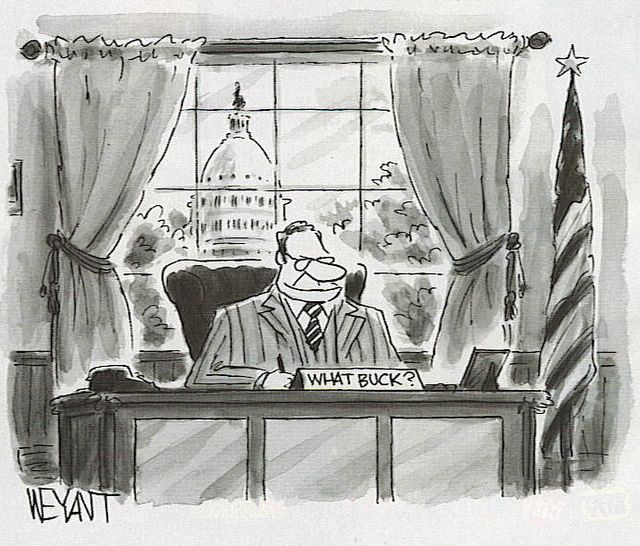
This is self-explanatory (The New Yorker July 25, 2005) Posted by Picasa

Sunday, July 31, 2005

This is a very interesting article, though there are several things to take under advisement. First, this guy's first language is definitely not English and second, realize that burying airplanes is very different than burying WMDs...


A U.S. military search team examines a Cold War-era MiG-25R Foxbat B, the fastest combat aircraft today(*), that lay buried beneath the sands in Iraq. Several MiG-25s and Su-25 ground attack jets have been found buried at al-Taqqadum air field west of Baghdad.

Side-view of the Iraqi MiG-25RB (actually Soviet-controlled-- read the article)


By the way, Al-Taqqadum air field has been taken over by the US Army and they changed its name to (FOB) Camp Ridgeway from October 2003 to March 25, 2004, when it was renamed Camp Taqqadum since the US was desperate for political reasons to put an "Iraq face" on their presence.

* That the MiG-25RB is "the fastest combat aircraft today" is a lot more overblown than it might make you believe. First, reaching its top speeds would necessarily destroy the engines (making it a very expensive sprint). Second, even below its top speed, it was comparably difficult to maneuver, making it vulnerable to surface-to-air missile technology developed in the mid-1970s. Additionally, lots of other Soviet and other countries' aircraft were built for tasks other than combat that went faster than that. See this page for more details.

Saturday, July 30, 2005


Welcome back to the States, Dora! Posted by Picasa

Friday, July 29, 2005

A very good point:

U.S. neglecting weapon for next Cold War: Education
June 6, 2005 Monday
San Antonio Express-News
BY: David Smith

Oct. 4, 1957, the day the Soviet Union launched Sputnik and propelled the world into the space age, was described by many as the shock of the century. This technologic feat, coming at the beginning of the Cold War, sent shivers down the backs of our military, political and scientific communities.

The United States, yet to venture into space, had been out-maneuvered, and there was deep concern about our academic and scientific prowess.

President Dwight Eisenhower's science advisers warned that the Soviet Union's emphasis on science and math was providing an edge that couldn't be overcome if something wasn't done quickly. Eisenhower himself called training scientists and engineers "the most critical need of all ... People are alarmed and thinking about science, and perhaps this alarm could be turned toward a constructive result."

A sense of urgency permeated politics, business and the halls of academia, resulting in the kind of "constructive result" that Eisenhower envisioned. A bold new partnership was forged involving the federal government, private industry and colleges and universities.

The consensus was that colleges and universities, the incubators of scientific talent, had to be rejuvenated and bolstered. Universities and colleges responded by changing curriculum and adding laboratories and classrooms.

In 1958, Congress passed the $1 billion National Defense Education Act, which paid for student loans, scholarships and scientific equipment for public and private colleges. The act emphasized the study of math, science and foreign languages.

As a result of these and other improvements, the United States became the undisputed world leader in scientific advancement.

Despite impressive accomplishments, many would argue that almost 50 years after the launch of Sputnik, the United States is once again being challenged and surpassed in our institutions of higher learning.

State budgets have been cut, and the percentage of public dollars available for public universities and colleges has declined dramatically. Many public institutions are receiving less than one-third of their budget from state appropriations. While policy-makers and industry leaders are calling for increased access, colleges and universities are being forced to shift more costs to families and students.

At the same time, there has been a sharp decline in the number of Nobel laureates from the United States, a drop in the percentage of publications by top U.S. physicists in major journals and declines in the numbers of new U.S. doctorates and the number of scientific papers by Americans. One-quarter of industrial patents filed in the United States are now submitted by researchers in Japan, Taiwan and North Korea.

One cannot criticize our competitors in this global market. But one can ask why we are not aggressively addressing our shifting demographics and hunger for a labor force with skill sets that can only be realized through undergraduate and graduate education. This nation is witnessing a significant shift in the socioeconomic and cultural makeup of our future labor force. This new cohort of young talent is coming from families who have never had a graduate of a college or university.

These trends define no less of a challenge nor should they invoke any less fear than the launch of Sputnik. Sputnik was a wake-up call that galvanized the nation. The vision was clearly enunciated, and the public investment in higher education was forthcoming. The return on investment was a golden age of scientific accomplishment that transformed medicine, engineering, space travel and even passenger safety.

The question remains: Do we see as clearly as we did in 1957 our challenge and purpose? Will we stop the erosion in funding for colleges and universities? Could the "new Cold War" be a race to maximize human potential in this country and re-establish our leadership through a competitive and competent work force?

Failure to meet this challenge could force an epic confrontation in national policy that pits the exportation of jobs against the importation of labor. We can't afford to take such a risk. Our nation -- and children -- deserve better.


David Smith is chancellor of the Texas Tech University System.

Thursday, July 28, 2005

This is great!

Oedipus: The Movie

An 8-minute version, as performed by vegetables

Take a look at their Press Packet-- truly inspired!

Wednesday, July 27, 2005

Wisdom from a fortune cookie:

The best prophet of the future is the past.
Applebaum makes a very good point here-- thanks for sending this to me, Symi!


Think Again, Karen Hughes
By Anne Applebaum
The Washington Post
Wednesday, July 27, 2005; Page A21

Only two senators were in the room when Karen Hughes testified at her confirmation hearings. When it came time for the Senate Foreign Relations Committee to vote on her nomination yesterday, she was easily approved. And thus with no discussion and no debate, Hughes takes over the least noticed, least respected and possibly most important job in the State Department. Her formal title is undersecretary of state for public diplomacy and public affairs. In plain English, her job is to fight anti-Americanism, promote American culture and above all to do intellectual battle with the ideology of radical Islam, a set of beliefs so powerful that they can persuade middle-class, second-generation British Muslims to blow themselves up on buses and trains.

Presumably, President Bush selected Hughes for this task because she was very good at running his election campaigns. And indeed, in the testimony she gave last week to a nearly empty room, she sounded like she was still running an election campaign. Like Hillary Clinton, she said she wanted people around the world to know that she would be "listening" to them: "I want to learn more about you and your lives, what you believe, what you fear, what you dream, what you value most." Like Jesse Jackson, she deployed alliteration, alluding to the four "E's": "engagement, exchanges, education and empowerment."

Unfortunately, Hughes's most important constituents aren't going to respond to engagement and empowerment, let alone exchange and education, unless the latter involves those flight schools where they don't teach you how to take off or land. It has become clear in Iraq, if it wasn't already, that what we call the "war on terrorism" is in fact a small part of a larger intellectual and religious struggle within Islam, between moderates who want to live in modern countries, and radicals who want to impose their extreme interpretation of sharia , or religious law. So far, most of the money, and most of the "public diplomacy," has been channeled to the radicals. Consider, for example, an extraordinary report published this year by the Center for Religious Freedom, a division of Freedom House, which surveys more than 200 books and pamphlets collected at mosques and Islamic centers in U.S. cities. Most were in Arabic. All were published by the Saudi government or royal family, and all promote the extreme form of Wahhabi Islam found in Saudi Arabia. The books reflect contempt for the United States, condemn democracy as un-Islamic, and claim that Muslims are religiously obliged to hate Christians and Jews. Most insidiously, the documents denounce moderate Muslims, especially those who advocate religious tolerance, as infidels. If a Muslim commits adultery or becomes a homosexual, one pamphlet -- published by the Saudi government's ministry of Islamic affairs -- advises that "it would be lawful for Muslims to spill his blood and take his money."

I am citing this study not merely to finger the Saudis, but also to show what we are up against. The Saudi king's own Web site boasts of his support for mosques and schools in Lagos, Islamabad, Madrid, Buenos Aires and elsewhere. A friend reports recently seeing a new Saudi mosque in Kosovo. We have to assume that the materials found in the United States exist in all of those places, too.

To fight these ideas, friendly state visits from Laura Bush will not suffice. Neither will more Britney Spears songs for Muslim teenagers, which is what we play on U.S.-funded Farsi and Arabic radio in the Middle East. Instead, we need to monitor the intellectual and theological struggle for the soul of Islam, and we need to help the moderates win. This means making sure that counter-arguments are heard whenever and wherever Muslim clerics and intellectuals are talking, despite the impact of Saudi money.

The United States has engaged in a project like this once before. In the 1950s and '60s, the West European left was also bitterly divided, with social democrats on one side and pro-Soviet communists on the other. We backed the social democrats. CIA money was used, for example, to found Encounter, a small but influential magazine whose editors promoted not just pro-Americanism but also the principles of democracy and capitalism, largely through allowing both sides to argue their cases.

I concede that the analogy is not exact, that the present case is far more difficult and that we have a long way to go. At the moment, the State Department probably spends more money denying visas to moderate Muslim scholars than it does funding magazines for them to write in. The traditional tools of public diplomacy -- American libraries, Fourth of July parties, "citizen ambassadors" -- are uniquely unsuited to the task of encouraging debate within Islam as well. But Hughes has nothing to lose by dropping the four "E's," going back to the rest of the alphabet, and thinking way, way outside the box. Judging by Bali, Madrid, London and Sharm el-Sheikh, not to mention New York and Washington, whatever we're doing right now, it isn't working.

Tuesday, July 26, 2005


That's one cool (and cute) cat! Posted by Picasa
Trying to figure out what happened to my comments widget-- bear with me and I'll see if I can get the new blogger comments widget working here...

Sunday, July 24, 2005

No reason for this poem-- I've just really liked this one.

The Love Song of J. Alfred Prufrock


By T.S. Eliot


S’io credesse che mia risposta fosse
A persona che mai tornasse al mondo,
Questa fiamma staria senza piu scosse.
Ma perciocche giammai di questo fondo
Non torno vivo alcun, s’i’odo il vero,
Senza tema d’infamia ti rispondo.


Let us go then, you and I,
When the evening is spread out against the sky
Like a patient etherised upon a table;
Let us go, through certain half-deserted streets,
The muttering retreats
Of restless nights in one-night cheap hotels
And sawdust restaurants with oyster-shells:
Streets that follow like a tedious argument
Of insidious intent
To lead you to an overwhelming question …
Oh, do not ask, “What is it?”
Let us go and make our visit.

In the room the women come and go
Talking of Michelangelo.

The yellow fog that rubs its back upon the window-panes,
The yellow smoke that rubs its muzzle on the window-panes
Licked its tongue into the corners of the evening,
Lingered upon the pools that stand in drains,
Let fall upon its back the soot that falls from chimneys,
Slipped by the terrace, made a sudden leap,
And seeing that it was a soft October night,
Curled once about the house, and fell asleep.

And indeed there will be time
For the yellow smoke that slides along the street,
Rubbing its back upon the window-panes;
There will be time, there will be time
To prepare a face to meet the faces that you meet;
There will be time to murder and create,
And time for all the works and days of hands
That lift and drop a question on your plate;
Time for you and time for me,
And time yet for a hundred indecisions,
And for a hundred visions and revisions,
Before the taking of a toast and tea.

In the room the women come and go
Talking of Michelangelo.

And indeed there will be time
To wonder, “Do I dare?” and, “Do I dare?”
Time to turn back and descend the stair,
With a bald spot in the middle of my hair—
[They will say: “How his hair is growing thin!”]
My morning coat, my collar mounting firmly to the chin,
My necktie rich and modest, but asserted by a simple pin—
[They will say: “But how his arms and legs are thin!”]
Do I dare
Disturb the universe?
In a minute there is time
For decisions and revisions which a minute will reverse.

For I have known them all already, known them all:—
Have known the evenings, mornings, afternoons,
I have measured out my life with coffee spoons;
I know the voices dying with a dying fall
Beneath the music from a farther room.
So how should I presume?

And I have known the eyes already, known them all—
The eyes that fix you in a formulated phrase,
And when I am formulated, sprawling on a pin,
When I am pinned and wriggling on the wall,
Then how should I begin
To spit out all the butt-ends of my days and ways?
And how should I presume?

And I have known the arms already, known them all—
Arms that are braceleted and white and bare
[But in the lamplight, downed with light brown hair!]
It is perfume from a dress
That makes me so digress?
Arms that lie along a table, or wrap about a shawl.
And should I then presume?
And how should I begin?
. . . . .
Shall I say, I have gone at dusk through narrow streets
And watched the smoke that rises from the pipes
Of lonely men in shirt-sleeves, leaning out of windows?…

I should have been a pair of ragged claws
Scuttling across the floors of silent seas.
. . . . .
And the afternoon, the evening, sleeps so peacefully!
Smoothed by long fingers,
Asleep … tired … or it malingers,
Stretched on the floor, here beside you and me.
Should I, after tea and cakes and ices,
Have the strength to force the moment to its crisis?
But though I have wept and fasted, wept and prayed,
Though I have seen my head [grown slightly bald] brought in upon a platter,
I am no prophet—and here’s no great matter;
I have seen the moment of my greatness flicker,
And I have seen the eternal Footman hold my coat, and snicker,
And in short, I was afraid.

And would it have been worth it, after all,
After the cups, the marmalade, the tea,
Among the porcelain, among some talk of you and me,
Would it have been worth while, 90
To have bitten off the matter with a smile,
To have squeezed the universe into a ball
To roll it toward some overwhelming question,
To say: “I am Lazarus, come from the dead,
Come back to tell you all, I shall tell you all”—
If one, settling a pillow by her head,
Should say: “That is not what I meant at all.
That is not it, at all.”

And would it have been worth it, after all,
Would it have been worth while,
After the sunsets and the dooryards and the sprinkled streets,
After the novels, after the teacups, after the skirts that trail along the floor—
And this, and so much more?—
It is impossible to say just what I mean!
But as if a magic lantern threw the nerves in patterns on a screen:
Would it have been worth while
If one, settling a pillow or throwing off a shawl,
And turning toward the window, should say:
“That is not it at all,
That is not what I meant, at all.”
. . . . .
No! I am not Prince Hamlet, nor was meant to be;
Am an attendant lord, one that will do
To swell a progress, start a scene or two,
Advise the prince; no doubt, an easy tool,
Deferential, glad to be of use,
Politic, cautious, and meticulous;
Full of high sentence, but a bit obtuse;
At times, indeed, almost ridiculous—
Almost, at times, the Fool.

I grow old … I grow old …
I shall wear the bottoms of my trousers rolled.

Shall I part my hair behind? Do I dare to eat a peach?
I shall wear white flannel trousers, and walk upon the beach.
I have heard the mermaids singing, each to each.

I do not think that they will sing to me.

I have seen them riding seaward on the waves
Combing the white hair of the waves blown back
When the wind blows the water white and black.

We have lingered in the chambers of the sea
By sea-girls wreathed with seaweed red and brown
Till human voices wake us, and we drown.

Friday, July 22, 2005

This is a fascinating interview (on Fresh Air by Terry Gross) of former Republican Senator and US Representative to the United Nations, John Danforth. I highly recommend you listen to it:

Preface/background included for the interview by NPR/Fresh Air:

A retired Episcopal priest, Danforth represented Missouri in the Senate for 18 years. He is also the former U.S. ambassador to the United Nations. Recently, Danforth has been outspoken about the Christian conservative bent of the GOP, writing that "Republicans have transformed our party into the political arm of conservative Christians."

Wednesday, July 20, 2005

I saw an amusing t-shirt on the metro the other day:

It was mainly blue with a red star at the middle left. On the same level as the star were two lines of white lettering: REPUBLICANS FOR VOLDERMORT

Tuesday, July 12, 2005

The Novak/Plame scandal seems to be picking up momentum--

It finally has gotten to the point of journalists challenging directly what Scott McClellan, the White House Press Secretary, says. Read through this transcript of Monday's press briefing and pay special attention to the question and answer portion.

For some concise background and analysis, read this:
White House Stonewalls on Rove Scandal

Monday, July 11, 2005

Surprise! The administration is finally realizing that Missile Defense, a hangover from the Reagan years for which no test has really been successful, is not a way to keep the US secure.

Military Revamping Missile Defense System
A unique way to profile the man who has since become the Secretary General of NATO--

One day early in 2000 the world of Jaap de Hoop Scheffer, then leader of the Netherlands' Christian Democrats (CDA), seemed to be falling apart. "It was as if 20 years of my eldest child's education had just been thrown down the drain," he recalls.

His daughter Caroline had just introduced her parents to her new boyfriend, Jimmy, in a restaurant in The Hague. He was a strange, English-speaking man with an earring and long hair. Born in 1947, he was a year older than De Hoop Scheffer and had been earning his living as an entertainer on some sort of “Love Boat” in the Caribbean. Jimmy was now studying astrology with a view to becoming a palm reader on a cruise ship and wished to take Caroline, who was a law student, with him on the next cruise. Jimmy also appeared to be the marrying type, unashamed of the fact that he had already been married four times.

De Hoop Scheffer and his wife Jeannine were not amused. But they tried to behave as if nothing was wrong. Only after Jimmy and Caroline left the table for a moment did they explode in frustration.

Jeannine: "Oh my God, what a mess."
Jaap: "We've just got to get through this. We'll have a serious talk with her tomorrow."
Jeannine: "This is just unbelievable."
Jaap: "It's unacceptable."
Jeannine: "What a complete idiot."
Jaap: "This is a disaster. He's awful and he’s manipulating her."

De Hoop Scheffer quickly devised a rescue plan: he would get Caroline's best friend to persuade her to change her mind......


Read more of the profile Jaap de Hoop Scheffer: Diplomatic long distance runner

Saturday, July 09, 2005

A Unique Type of Fire Escape


Burning Ambitions:A Russian-Designed System for Surviving Fires in Tall Buildings

The Economist
June 25, 2005

THE Paris air show is a notoriously chaotic affair. This year's, which finished on June 19th, was no different from usual. But in a quiet corner of the show, a new way of clocking up air miles was to be found. It looks like a small, orange, inflatable swimming pool with a pointy underside. And strapped inside it is a Biggles-like doll complete with goggles, moustache and flying scarf. It is an escape-pod for people trapped in tall, burning buildings. And it is the product of the Lavochkin Association, an aerospace firm based in Khimki, near Moscow.

There is, at the moment, no convenient way to leave a tall building if the emergency staircases are on fire and the fire brigade has not arrived or its ladders will not reach. Nor are conventional parachutes an answer. As is well known to participants in the sport of Base Jumping (a mind-bogglingly dangerous activity that involves parachuting from static objects), parachutes have problems when launched from tall buildings. For a start, they may not have time to open properly. Even if they do, they can get snagged on the way down. And on top of that, if a building is burning they are liable to catch fire. Hence the Lavochkin escape pod—or "rescue system", as the firm prefers to call it.

According to Yuri Boulanov, one of Lavochkin's representatives at the air show, the idea is to create a cheap, inflatable structure that can be compressed into a backpack, like a parachute. The pod is designed with an inflatable tube around its edges, which should cause it to bounce off the walls of a building. And the final version will be made from some, as yet unspecified, fire-retardant material. As a bonus, and unlike a parachute, it will operate safely from altitudes of five metres and above—which would make it suitable even for the top floors of houses.

In an emergency, someone wishing to leave in a hurry would strap on the backpack and jump, pulling a ring as he did so. The pod would inflate, surround him instantly and bear him gently to the ground. At least, that is what happens to the digital simulation in the company's promotional video.

The pod on display at Lavochkin's stand was actually a one-metre diameter prototype. The full-scale device, currently undergoing tests with a sensor-loaded dummy as its passenger—is six metres across and should be able to carry someone weighing up to 120kg. Mr Boulanov says the commercial version should cost around $1,000.

If it all sounds unlikely, it is worth remembering that it is now possible to lob a spacecraft all the way to Mars and have it land safely using an inflatable shell similar to Lavochkin's. Now all that is needed is some way of getting through the sealed windows with which most tall building are glazed.

Friday, July 08, 2005


Congrats to Dana and David!!!!  Posted by Picasa

Thursday, July 07, 2005

Whew! I'm finally back in DC after a great time in Florida, enjoying Dana and David's wedding as well as spending some wonderful time with Symi, but the process of getting there and back was exhausting.

Going: My first flights (I had to change planes in Atlanta) hit major snags and ended up sitting on the tarmac for hours on end in the middle seat of the very last row of the plane. I finally got where I needed to go at 3AM when I was supposed to arrive at about 10:30PM.

Returning: After being delayed over 45 minutes on the train to Fort Lauderdale Int'l Airport, my flight was cancelled after three hours of them pushing back the departure time. Since it was the last flight of the night, they were legally responsible for putting people up for the night since the reason for the cancellation was that their crew would have been on the job beyond the federal time limit. Still, they refused to pay for hotel or ground transportation. I had to spring for both and wait for the 5:30p flight the next day-- thankfully I got on to the 1:10p flight as a standby and finally got home at about 4pm.

US Air is going to hear from me.

Friday, July 01, 2005

Congratulations to Dana and David on their upcoming wedding this weekend!!

I'm heading down to Florida for the wedding and July 4th holiday-- we'll see how quickly I melt into a puddle with the humidity.

And I'm going to be seeing Symi! Yaaay! :-)

Wednesday, June 29, 2005

Looking around the web for some unrelated information, I happened to discover that the little village (barely 5,000 people) in the extreme northeastern corner of the Czech Republic where I lived immediately after the Velvet Revolution has put up a municipal website.

Obec Bystrice

I realize that the text will be all Greek (or Czech) to most of you but there are still some good photos up there.

Monday, June 27, 2005

The UN was founded in San Francisco 60 years ago yesterday. For all its weaknesses, remember that it has proved to be the most successful organization of its kind, especially that has lasted as long as it has. Nothing else has really come close.

Historical background on the founding of the United Nations

Friday, June 24, 2005

Really interesting and a big problem with a lot at stake:

Spotting Bushmanders

by Mark Monmonier (academic page) (personal page), author of Bushmanders and Bullwinkles: How Politicians Manipulate Electronic Maps and Census Data to Win Elections

Remember that this book was published in 2001, before the Bush Administration really got going.

Congrats again, Michael Strong! Posted by Hello

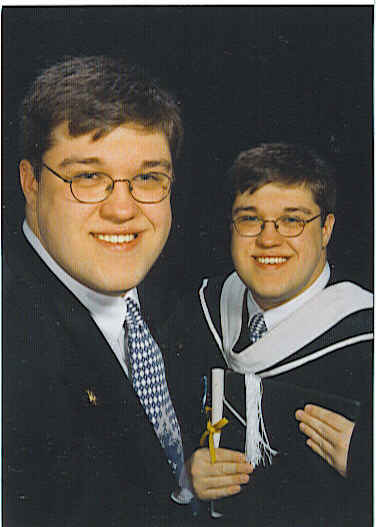
Congrats to Michael Strong who graduated from George Washington University this spring-- I've only just got the photos and the wherewithal to post them.  Posted by Hello

Thursday, June 23, 2005

I've been having a great time going through a website called Footnotes to History, a collection of short descriptions of failed attempts to set up independent states (countries) around the world. Some of these little vignettes are fascinating and some of these are really funny. I encourage you to look through the whole webpage but I wanted to put the best ones up here for people to read:

Free District of Lake Michigan In 1886, a Chicago businessman named Cap Streeter built a steamboat. On its first voyage, the boat was grounded on a sandbar just off Chicago's municipal dump on the Lake Michigan coast. Sensing an opportunity to make the most of his loss, Streeter built a causeway to shore and underbid the dump. Soon, Streeter's sandbar had multiplied to 180 acres, and he filed for squatter's rights as a Civil War veteran. He soon opened up business selling alcohol, which was strictly regulated by Illinois law. In 1893, the Columbian Exposition created a boom along the Chicago waterfront. The wealthy landowners began to see Streeter as a threat instead of a nuisance, and hired street thugs to expel him. However, Streeter had hired a force of his own, and fought off the invaders.

The raids continued for several months, and Streeter, exasperated, declared himself independent of Illinois. The next day, Chicago police raided the Free District. After Streeter blackmailed and fought the police into acquiescence, the landowners brought in a group of Missouri bandits. When they attacked, Streeter shot and killed their leader. He was convicted of murder, and the Free District was torn down. When he was pardoned two years later, Streeter lost a suit to regain his land. He died in 1921, owning only a hot dog stand. His island is now the "Golden Coast", the most expensive land in Chicago.


Great Republic of Rough and Ready Rough and Ready was founded near a rich seam of gold during the California Gold Rush in 1849. By 1850, the town was thriving, and over a thousand people voted in the elections of that year. The flinty miners seceded from the Union that year to protest a new ore tax. However, the Roughandreadians rejoined the United States in June of the next year, in order to become the site of a new post office. (And also to enjoy the upcoming July 4th celebrations with a guilt-free conscience)

North Dakota In 1933, William "Fighting Bill" Langer took office as Governor of North Dakota. Although he was hugely popular, he soon exhausted his support when he demanded that state employees contribute to the state Republican party. As some of these salaries were paid with federal money, he was convicted of conspiring to defraud the U.S. government in June of 1934. Langer refused to accept the verdict or to resign from office. Ole Olsen, the lieutenant governor, asked the state's Supreme Court to order Langer to resign. On July 17, 1934, the Supreme Court of North Dakota declared Olsen the legitimate governor. Langer's reaction was not what the Supreme Court expected- before the Court's order was filed on the 18th, Langer met with ten of his friends and declared North Dakota's independence. He then barricaded the governor's mansion and declared martial law. Not until the Supreme Court met personally with Langer did he relent, revoking his declaration and bringing North Dakota back into the Union.

Incredibly, Langer was later re-elected. From all accounts, he served out his second term in a much quieter fashion.


Isle of Dogs The Isle of Dogs is a small peninsula in the middle of London, formed by a bend in the River Thames. The area was historically a dumping ground for poor Londoners, who often felt they received an unfairly small allocation of resources. In 1970, a group of residents declared independence in protest, barricading the single road leading into the Isle. A Labour city councilman named Ted Johns was elected President. The protest served its purpose; extra funding was allocated, and the Republic was dissolved.

It turns out this was merely the beginning of the area's woes; in the name of urban renewal, the government turned the Isle of Dogs into Canary Wharf, burying the district's history under an abysmal pile of postmodern "architecture".


Sealand In the 1960s, one of Great Britain's more productive cottage industries was pirate radio. The painfully bland BBC and the painfully bland government of Harold Wilson took umbrage, and soon the pirate transmitters were forced underground. After one pirate station began transmitting from a ship outside the three-mile limit of the UK's waters, Roy Bates and Ronan O'Rohilly, both owners of pirate radio stations, got to thinking.

The North Sea at this time was littered with Second World War-vintage radar platforms. In 1966, Bates and O'Rohilly occupied one and called it Sealand. They began hatching moneymaking schemes ranging from not just a pirate radio station, but also a gambling resort and a corporate tax haven. As the freshly-minted nation's prospects rose, so did the tension between the diumvirs of the baseball-diamond sized empire. Bates seized the tower. In June of 1967, O'Rohilly launched an offensive, which Bates and his men repulsed with guns, Molotov cocktails, and a surplus flamethrower. Upon hearing that the Royal Marines were preparing to seize the platform, Bates declared Sealand's independence and himself Prince Roy on September 2. When a Royal Navy ship demanded that Bates abandon the platform, the Prince opened fire. On a jaunt back to the old country, Bates was arrested and brought before a British court on a number of charges related to the incident. The case was dismissed in October of 1968; the court agreed that Prince Roy's Sealand was outside of British jurisdiction.

Sealand stayed out of the news until a German businessman toured Sealand a few years later. During negotiations, the German’s hired Dutch goons kidnapped the crown prince and set him back ashore. Prince Roy rapidly got together an army, hired a helicopter, and retook the tower. Since the German had accepted Sealand citizenship, Bates arrested him for treason. Over the next seven weeks, the German government repeatedly appealed to the British Foreign Office, which insisted that it had no jurisdiction. Further vindicated, Bates eventually released the German without payment of his 75,000 Deutschmark fine.

The next uproar took place during the Falkland Islands War of 1982. Argentina's initial success rapidly eroded, and the Argentines conceived of a desperate plan. They contacted Bates and asked to lease Sealand as a missile base, hoping to destroy British morale. Bates swallowed down his mercenary impulses and declined. In a completely unrelated matter, Britain extended its territorial waters to the 20 kilometer limit later that year, soon after dynamiting another tower near Sealand. Prince Roy refused to give up the ship, though. In 1999, he entered into negotiations with HavenCo to lease the entire nation. HavenCo (naturally) now plans to turn Sealand into an offshore data haven. Since the EU has already extended Sealand a certain degree of de facto recognition, it remains to be seen how these plans will develop.


Isle of the Roses In the early 1960s, engineering professor Giorgio Rosa constructed a platform eight miles offshore from the Italian city of Rimini. After a storm swamped the platform, another was erected in 1965. The 4,000 square foot platform boasted several businesses. The Italian authorities took little notice of the platform, since it was in international waters at the time, until May 1, 1968, when Rosa declared the platform an independent nation.

Two months later, the platform was illegally occupied by the Italian Navy, who then illegally removed Rosa and proceeded to illegally destroy the entire country with dynamite. The Isle of the Roses is therefore, along with Carthage and New Atlantis, one of the few nations to be utterly removed from the face of the earth by military action.


Jefferson Northern California and southern Oregon have long been dissatisfied with their respective governments. This exasperation erupted over the failure of the government to provide funding for new roads. A number of border counties sent delegates to demand better treatment at a November, 1941 meeting in Yreka, California. The local board of county supervisors, urged on by the Chamber of Commerce, allocated funds to further the cause of independence and designated Yreka the temporary capital of the State of Jefferson. On December 4, Judge John Childs was elected governor of the new state. National opinion was favorable, but fate was not; three days later, the Japanese attacked Pearl Harbor. The inhabitants of Jefferson put aside their bid for the sake of national unity. All ended well; the government built a number of roads through the area to transport timber during the war.

New Atlantis This nation was founded on an 8'x30' platform in the Caribbean by Leicester Hemingway, Ernest Hemingway's brother. The nation boasted eight citizens during its brief independence in 1964, but was utterly destroyed by fishermen who tore up the platform for the lumber.

They did not retrieve the anchor and Ford engine block which tethered New Atlantis. Undaunted, Hemingway anchored another platform christened Tierra del Mar. The U.S. State Department quickly contacted Hemingway and "actively discouraged" any claims of sovereignty, fearing Tierra del Mar could serve as a springboard for annexation of nearby islands from the Bahamas.


North Dumpling North Dumpling is a scenic island (complete with New England lighthouse) off the coast of New York. It was purchased in the 1980s by inventor Dean Kamen (the man behind the Ginger scooter hoohaw). In the late 80s, Kamen decided to build a wind turbine to generate power for the island. When the state government refused him a permit, Kamen seceded from the United States, establishing a currency with the value of pi, signing a non-aggression pact with President George Bush, and naming Ben and Jerry Joint Chiefs of Ice Cream. Kamen's position as an inventor of medical devices and major player in the state politics of New Hampshire has probably saved him from the fate of, say, Justus Township.

Hay-on-Wye In 1977, Hay-on-Wye was just another decaying British town past its prime. On April Fool's Day, local bookstore owner Richard Booth decided to declare himself King of Hay-on-Wye, both to drum up business and protest the seeming indifference of the British government to Hay's plight. The move inspired Hay to remake itself as a tourist destination, and today Hay thrives as the first of the "international book towns", with thirty bookstores (one per 65 inhabitants) and 500,000 annual visitors. King Richard still actively serves in community functions, and as the owner of a very fine bookstore.

Muscongus Island Muscongus Island is located off the shore of Maine. In 1860, the island was inadvertantly left off the state’s official maps, and the residents were therefore not allowed to vote. In retaliation, Muscongus Island declared its independence. Like many respectable residents of rural America, they enforced this by firing their rifles at any tax collectors sighted on the island. The Muscongans decided not to press the point after the Civil War began, although the declaration of independence was not formally withdrawn until 1934.

Free State of Jones According to legend, Jones County in southern Mississippi seceded from the Confederacy during the Civil War. However, no evidence exists that such an event took place. The legend appears to have some basis in fact: the nickname "Free State of Jones" was used for the county, but was used in antebellum Mississippi and referred to the paucity of slaves in Jones County. A military operation was launched by the Confederate Army against an organization calling itself the Republic of Jones in late 1863 and early 1864. The Republic of Jones (and perhaps a second group called the Jones County Confederacy) appear to have been bands of Confederate Army deserters, who took refuge in the swamps and woods of Jones County. The Natchez Courier, a pro-Union newspaper, published a story lampooning the Confederacy in 1864, involving the supposed secession of Jones County. Encouraged by oral tradition, the legend has persisted to the present day.

Embassy of Lithuania, Latvia and Estonia Throughout the Cold War, the United States refused to recognize the annexation of the Baltic republics (Lithuania, Latvia and Estonia) by the Soviet Union during the Second World War. Therefore, the United States maintained that the ambassadors of those nations in Washington still represented the only lawful authority in the Baltics, and that the embassies were sovereign territory controlled by the Baltic governments-in-exile. Until the Baltic republics regained their independence in 1990, the "Presidents" of all three nations resided for forty years at the still-independent embassy buildings.

Provisional Government of Kentucky In April 1861, Kentucky's government chose the better part of valor and declared that the state would be neutral in the looming Civil War. This neutrality was ended when Confederate and Federal troops entered Kentucky in September; the Confederates retreated, and the Army of the Cumberland soon established a militia and a series of military camps. The sympathies of many Kentuckians lay with the Confederacy, however, and in November of 1861, delegates met at Russellville to declare Kentucky's independence. The new Provisional Government established its capital at Bowling Green and sent representatives to the Confederate government. It soon became apparent that the Provisional Government existed on paper only, and its governor left in February of 1862 to join the Confederate Army. Thereafter (although a government-in-exile continued at Richmond) Confederate Kentucky remained only a pipe dream.

Kaifeng Jews Jewish settlements existed throughout medieval China. The settlement at Kaifeng was notable for its size and duration. Founded around the year 1000, by the 16th century the Jewish community engaged in agriculture, trade, the civil service, and the army. The Chinese were tolerant of the Jews, who began to incorporate Confucian ideas in their thought, and who were gradually assimilated to the point where they were indistinguishable from other Chinese. The community's vibrant life suffered a dramatic shock in 1810, when Kaifeng's last rabbi died. Although most of the Jewish traditions have been lost and no organized Jewish community groups exist, the descendants of the Jewish colony still fiercely identify themselves as Jewish.

Abalonia The USS Abalonia was a concrete cargo ship, constructed for the purpose of becoming an independent nation. The company which built it hoped to anchor it in rich shellfish beds on the Cortes Bank, 100 miles off the coast of San Diego, and claim jurisdiction over the area. Shortly after the Abalonia's launch in 1969, it foundered and sank, nearly killing the crew. In the wake of the Abalonia fiasco, a second company began plans to build a platform on the Cortes Bank and declare it the nation of Taluga. The US government quickly gave notice that the Cortes Bank, as part of the continental shelf, fell within its jurisdiction.

Wednesday, June 22, 2005

Every year at about this time, NPR does a show on good books to choose for 'summer reading.' I just finished listening to this year's edition and it has some interesting recommendations, so I thought I'd post the link here:

Summer Reading 2005: Summer Reading Picks from Critics, Listeners

And here's another fun story from NPR:

Strong Bad Walks in Footsteps of Darth, Lex, J.R.

Take a listen to this interview with the producers of www.homestarrunner.com on NPR's news show All Things Considered.

What do you think? Is the whole thing "smooth 'n smarmy," like Strong Bad says?

Woo Hoo! The book is finally close to coming out!


Some of you will remember that I played a central role in organizing and running the symposium Eisenhower and National Security for the 21st Century, which was co-sponsored by the Eisenhower Memorial Commission (where I work) and the Industrial College of the Armed Forces at the National Defense University and held at Fort McNair from January 26-28, 2005.

We've been working hard to get at least some of the insights developed during the symposium in book form and we're finally getting close to releasing it!

The book, Forging the Shield: Eisenhower and National Security for the 21st Century will hopefully be released in July sometime but the publisher, Imprint Publications, has just put background and purchase information up on its website. Check it out!!

Tuesday, June 21, 2005

And now for something completely random-- but still interesting.

The website of the Qaanaaq (Greenland) Tourist Office, billed as the world's northernmost municipality.

Friday, June 17, 2005

Too much to say about this. I'll leave it up to you.

Robocop Camera Photographs Crooks... Then Tells Them To Beat It

Wednesday, June 15, 2005

Dell sent me a new HD and it's working-- technically. Now I've just got to reinstall everything and get all the hardware drivers loaded. That and figure out how to connect up to the rather strange internet setup. (I'm writing this from work, by the way).

Ah, well... back to it...

Monday, June 13, 2005

Argh...

My computer has finally given up the ghost-- or, rather, the hard drive has. I was on the phone with Dell and they finally decided that there was nothing for it but to replace my (corrupted) hard drive with a blank one. So, I'm going to be offline for a while until I get the replacement and re-install everything.

I'm soooooooo glad I backed most of my files up on Friday!

Friday, June 10, 2005

A word to the wise:

Never let a computer know you're in a hurry.

Thursday, June 09, 2005

I was reading in last week's Economist's Special Report on France and the EU and was intrigued by the following quote on French employment:

France's private sector boasts some of the world's leading companies, in industries such as cars, handbags, shampoo, yoghurt and insurance. Yet these firms tend to manage by employing relatively few people. Jobs are so thickly protected that employers hesitate to create them. Many resort to temporary or short-term contracts, or to interns. The upshot is a two-tier labor market: sheltered jobs for those who have them, and precariousness or joblessness for the rest.

I wonder if this might be true after a fashion in the United States, not because of oppressive employment regulation but due to the skyrocketing cost of health insurance and, according to employers, the crushing responsibility of actually paying a living wage.

Tuesday, June 07, 2005

Hi there-- my computer is being a bit problematic, so I might be offline for a little while. Don't really know what's going on but hopefully it'll just be a temporary glitch.

On a very different subject, this is a very interesting article:

Foreign Language Enrollments in United States Institutions of Higher Education, Fall 2002

Warm congratulations to this minty-fresh pair who celebrated their beautiful wedding over this weekend!  Posted by Hello

Friday, June 03, 2005

Wow! It's great to see an org like the WFP have a marketing success like this and it seems really interesting on a lot of different levels:

SURPRISE HIT HUMANITARIAN VIDEO GAME REACHES ONE MILLION PLAYERS
New York, Jun 1 2005 2:00PM
(UN News Centre)
Launched by the United Nations only six weeks ago, the first video game designed to teach children about global hunger has surpassed all expectations in the gaming world by reaching more than one million players in 40 countries.

What makes this achievement highly unusual is that no android attackers are blown away in the game, “Food Force,” released by the UN World Food Programme (WFP) in April. Instead, kids race against time to feed thousands of people on the fictitious island of Sheylan, alongside a crack team of emergency aid workers.

They pilot helicopters while looking out for hungry people, negotiate with armed rebels blocking a food convoy, and use food aid to help rebuild communities. Along the way, they learn about the real world where over 800 million people are plagued by hunger each day.

“Finally! An educational game that rocks!” comments Watercoolergames.com

Available as a free download in MAC and PC formats through a dedicated website where information on global hunger can also be found, the world’s first humanitarian video game contains six different missions aimed at children 8-13 years old. Evidence of the response to the game includes thousands of comments posted on the site along with highest scores.

As of today, “password300” of China leads with 148,952,869 points.

According to John Powell, WFP Deputy Executive Director, the game is reaching 40 countries even though it is currently available in English only. Powell is looking for partners to help translate the game into other languages.

The WFP is also focussing on free distribution in schools around the world, backed by Yahoo! and Internet2, a Washington-based high-speed educational network. In addition, the game is supported by a community web site which includes lesson packs on world hunger in seven languages provided by the UN Food and Agricultural Organization (FAO).

Tuesday, May 31, 2005