Friday, January 12, 2007

This is a great spoof and I thought people might enjoy this. I hope to read Absurdistan soon.

Ten Days With Oblomov


By Gary Shteyngart
October 1, 2006
New York Times Book Review

DAY 1: At 11 in the morning, while I am still savoring the last moments of a fruitful sleep, a messenger brings to my doorstep a new translation of “Oblomov,” the famous 19th-century slacker novel by Ivan Goncharov, whose eponymous hero, a member of Russia’s lazy landed gentry, spends most of his time luxuriating in bed. “Looks like I came at the wrong time,” the courier says with a wink, mistaking my usual dishabille for interrupted coitus. I return to my bed and gaze unhappily at the thick tome in my hands. Right away I’m feeling sleepy.

DAY 2: “I asked for mayo on the side,” I scream at the woman who takes my phone orders from the local diner. “I have cholesterol issues. You want me to die.” The half-eaten turkey sandwich rolls off the bed, leaving me with my trusty, sweet-smelling comforter and the very thick volume of “Oblomov,” the famous 19th-century Russian slacker novel by Ivan Goncharov, newly translated by Stephen Pearl and published by Bunim & Bannigan. I leaf through it while looking at the ceiling. That reminds me, the light bulb in the bedroom needs to be changed. Maybe tomorrow. “Oblomov” consists of 443 pages of small type plus another xxiii pages taken up by the foreword and introduction. I sit up and cross myself several times. How in the name of Anton Pavlovich Chekhov did I get myself into this mess?

DAY 3: Overslept. One p.m. But not to worry. Today the earth will shake! Today I will tackle “Oblomov,” the famous 19th-century Russian slacker novel written by Ivan Goncharov. And then I will write the most insightful essay ever written on the subject — a short, funny, but oddly moving meditation (“This short and funny meditation oddly moved me,” important people will say over breakfast) on Russian laziness that will somehow tie in with the Internet-addicted, short-attention. ... To the devil with this apartment! And now the light bulb in the hallway is out as well!

DAY 4: I’m not making any promises to myself, but today might be the day. The day I change the light bulb. And read “Oblomov,” the famous book by you-know-who. The delivery boy brings a proper turkey sandwich, mayo on the side, and a monumental cup of black coffee. I fluff up the comforter to support my gentle behind, prop up my pillows in such a way that they won’t leave a red imprint upon my neck, and open the book. “There is something deeply Russian in the character of Oblomov,” Tatyana Tolstaya writes in the book’s foreword, something that “lies in the seductive appeal of laziness and of good-natured idleness.”

DAY 5: What time is it? My laptop has been purring urgently, distracting me from that famous Russian slacker novel by Ivan Goncharov, which seems to have gotten lost somewhere within the folds of my elephantine comforter. What’s this on my screen? Breaking news over the A.P. wire: “Boy George Reports for N.Y.C. Trash Duty.” The 1980’s pop legend has been nailed on drug charges and is being forced to collect garbage just a few blocks away from me on the Lower East Side. “You think you’re better than me?” the octogenarian-looking singer is shouting at members of the media. “Go home. Let me do my community service.” I should crawl out of bed this very instant and lend my support to Mr. George. As a young Russian immigrant, I learned a great deal of English by listening to his happy bisexual crooning (“Karma, karma, karma, karma ...,” I would stutter along). If only all that damned “Oblomov”-reading hadn’t made me so sleepy.

DAY 6: I wake up in a state of agitation and throw on my dressing gown. There’s no time for coffee or the Internet. I grab “Oblomov” and start to feverishly highlight all the relevant passages. Only 400 pages to go! And when I finish with this essay, I will screw in new light bulbs. And I will clean the windows, which are as dirty as my soul. I will forswear the turkey sandwich from the diner. I will buy a house in the countryside upstate like I’ve always wanted. I will learn how to drive. Yes, I will drive up to my little country home in a leased Prius and there I will raise serfs and radishes and real fresh turkeys to put between my rye bread. My whole being is on fire! I sit up in bed and start to breathe heavily. Then I fall asleep.

DAY 7: I dream I am urgently rowing a boat to a house that appears to be drowning in the middle of the Gulf of Finland, a faded mansion in the Russian rococo style. I clamber up the waterlogged stairs, and on the top floor, recumbent upon his divan, I find Oblomov. He looks just as the book has described him, “flabby beyond his years,” with “small pudgy hands, and soft shoulders.” His equally indolent servant Zakhar is asleep on top of the stove, snoring rhythmically.

“Ilya Ilyich,” I say to Oblomov. “We must get out of this house before we drown. The water is gaining the stairs and soon we will be done for.”

Oblomov shrugs, but looks at me good-naturedly. “Take me as I am and love what is good in me!” he says, per the book.

“Don’t you see, good sir!” I say. “We are blessed to live in fascinating places in momentous times. You in 19th-century St. Petersburg, and I in early-21st-century New York. We should bestir from our beds and take heed of what surrounds us. In your day there are great thinkers such as Friedrich Nietzsche and Fyodor Dostoyevsky; in my day William Bennett and Condoleezza Rice.”

“I hardly ever read,” Oblomov says, much as he does on Page 19 of Goncharov’s novel. “What is there for me to be curious about? You know why they write that stuff — it’s just for self-gratification. ...”

DAY 8: According to the Internet, Boy George is collecting trash under the Williamsburg Bridge, less than 200 yards away from me. Perhaps I should telephone A., who occasionally contributes to S— Magazine, or D., who does something or other media-related, and we can form a little investigatory posse. I picture A. and D. and R. and T. and all the rest of us soft-spoken, liberal-college-educated youngish people lying in our queen-size beds, the glow of our all-forgiving laptops lighting up our disheveled bedrooms. Scattered about us are torn underwear, the stubs of plane tickets issued three years ago, half-eaten turkey sandwiches, spent light bulbs, ironic “vacuum tube” radios from the 1950’s, and books. Not the books that used to sustain us when we first fell in love with words but piles of freshly minted ones that demand to be read and loved and blurbed and reviewed. Where do they all come from, these books? Why do so many people need to jot down their imaginings in bursts of sophisticated English? Why all these new translations of long-forgotten texts? Why can’t I finish this essay, put on some real clothes and walk out into the summer sunlight where Boy George and the rest of our civilization await me?

DAY 9: Maybe if I clean the windows there will be a great deal of natural light and I won’t have to bother with the light bulbs. The real estate broker had told me the windows in my building “pop right out for easy maintenance” but what if they “pop right out” and kill a passing pedestrian? I fall into a deep melancholic trance. The diner completely screwed up the order. The turkey sandwich turned out to be ham. The mayo is hardly on the side. Oblomov has lost the love of his life, Olga, to his best friend, the industrious half-German Stoltz. Rapscallions have taken advantage of his good nature and robbed him of his last kopeck. He has died in his own bed of a stroke.

DAY 10: “What is it that’s doomed you?” Olga asks her beloved Oblomov before she leaves him for good. “Oblomovshchina,” he tells her — the state of being Oblomov, a term that in Russia may as well connote the state of the entire country. Some, like Tatyana Tolstaya, believe Oblomov’s immobility is rooted in the influence of Eastern philosophy upon Russia and proclaims him “one of nature’s Buddhists.” Others point the finger at Oblomov’s overprotective mother, or at a quiet, indolent, utterly thought-free childhood spent at a Russian country estate. My analyst claims his passivity is most likely rooted in depression. Who knows? One thing is certain. All this thinking takes up precious time, and the late summer sun is no longer trying to break into my bedroom and grab me by the collar. The alarm clock glows deep red in the dark. Midnight. As the members of Oblomov’s household would say: “Well, that’s another day over, praise God!”

Gary Shteyngart’s most recent novel is Absurdistan.

Friday, January 05, 2007

This is a fun website that people might enjoy-- Happy Holidays, belatedly!

NORAD Tracks Santa

Saturday, December 30, 2006

Well, I'm still in California after I was supposed to leave this afternoon to ring in the New Year with Symi in Chicago. After 3 hours in the Palm Springs airport, my flight was cancelled and after several more hours, I finally got a spot on a direct flight tomorrow. All this because of bad weather in Dallas (through which I was transferring).

At least I have somewhere I could stay here. Some people ended up renting a car and driving to LAX or being routed through 4 or so cities while not having it guaranteed that the would even be able to leave from their subsequent destinations.

Crossing my fingers for good weather tomorrow.

Thursday, December 21, 2006

Turkmenbashi Dead!


Colorful Turkmen Leader Dies
by BURT HERMAN, Associated Press Writer


No matter where you went in Turkmenistan, there was no getting away from President Saparmurat Niyazov.

He's on every banknote and coin, his name proclaimed on billboards lining every main street. Golden statues of him are a landmark in every town. He was on TV and in newspapers, in schools and offices — his portrait even graces the cabin in planes run by the state airline.

Across Central Asia after the Soviet Union's 1991 collapse, signboards proclaiming the teachings of Vladmir Lenin were painted over with slogans preaching the newfound nationalism of the former local Communist leaders who held on to power.

But Niyazov, who died Thursday at age 66 of heart failure, had an exceptional flair for showmanship and put himself on display like few other authoritarian leaders. In a way, his regime was ironically transparent, allowing the public to see their leader in action on a regular basis.

Before the nightly news in Turkmenistan, a clock bearing the image of Niyazov glancing at his watch counted down the seconds for the latest bulletin.

The lead news item was always about the man called "Turkmenbashi," or "Father of all Turkmen," heading to villages for the harvest or meeting with visiting businessmen eager to get a cut of the country's energy spoils.

News broadcasts often lasted more than an hour — with the state-run channel's editors apparently wary of trimming anything about the president.

A typical newscast would be a virtual "day in the life" of the president, starting with Niyazov driving his black Mercedes to work, then perhaps hopping on a helicopter to a village to watch farmers in action.

Residents would sing and dance to the delight of the rotund Niyazov, who would regally wave his burly hands decked with golden rings and clap softly. There would be speeches by elders, and perhaps the president himself would take a scythe to a wheat stalk.

No matter what else was on TV, a golden profile of Niyazov beamed from the corner of the screen — the logo of his self-proclaimed "Golden Century" for the country.

In case you missed it the night before, government newspapers would always report the president's doings as their top story the next day.

In the capital of Ashgabat, the central landmark is a golden statue of Niyazov that rotates slowly during the day to face the sun. A grand cape flowing behind him had some residents joking privately that he looked like Batman. At night, lights make the statue visible even to planes landing at the city's airport. Across the city, are the beloved water fountains he erected despite the country's parched landscape.

All offices and schools are required to have rooms dedicated to studying a pseudo-philosophical tome authored by Niyazov called "Rukhnama," or "Book of the Soul."

The book has its own monuments, with a giant version of the pink-and-green covered volume gracing a central park that is home to yet more statues of Niyazov. Every evening, the book's cover mechanically opens.

The incessant propaganda doesn't mean the people of Turkmenistan are isolated from the world. Even though Niyazov sought to sever access to foreign media and travel, forests of satellite dishes sprout from apartment balconies where Turkmens turn to outside channels, often Russian, to get a relatively broader world view.

They are now watching to learn the fate of their country, where the omnipresent president gave few hints of a possible successor and the face that will be greeting Turkmens daily in the future.

Friday, August 25, 2006

Whew! Symi and I are finally seeing the floor of our new apartment after the movers showed up bright and early 8:00AM Monday morning to move us out of our great apartment in Cleveland Park to our cozy apartment on the Upper West Side. Since then, it has been quite a ride-- drilling holes in the walls (for mounted shelves) and being given a hand saw, pencil and measuring tape and told to cut our own shelves to size in the corner of Lowe's hardware store in Brooklyn.

We're making some progress now, though, now that we've got most of the shelves up. Hopefully we can get everything set before I have to go to my MIA orientation Monday morning at Columbia.

In the meantime, I got the following link from my friend Tricia with the subject line:

"Hi, I'm Trish and I'm a bibliophile!"

To which, I say "Hi "Trish! It's good to see you as part of the group!"

But you don't have to be a bibliophile to appreciate this link:

Red-Hot Library Smut

Enjoy!

Thursday, July 27, 2006

I've recently been enjoying reading this series of articles written by "The Frugal Traveler," aka Matt Gross of the New York Times, as he travels east through the Balkans, the Caucasus and now into Central Asia. This week, he is writing from Kyrgyzstan and he's heading into Xinjiang Province, China.

Friday, July 14, 2006

Wheeeeeeeeeee!!!! We finally have an apartment in New York City! Now I just have to find a way to pay for it in addition to my tuition...

Wednesday, July 12, 2006

A bit of poetry that I've always thought was great-- a propos of nothing...

THE CREMATION OF SAM McGEE
by
Robert William Service


There are strange things done in the midnight sun by the men who moil for gold
The Arctic trails have their secret tales that make your blood run cold;
The Northern Lights have seen strange sights, but the queerest they ever did see
Was that night on the marge of Lake Lebarge when I cremated Sam McGee.

Now Sam Mcgee was from Tennessee, where the cotton blooms and blows.
Why he left his home in the south to roam round the Pole God only knows.
He was always cold, but the land of gold seemed to hold him like a spell;
Through he'd often say in his homely way that he'd "sooner live in hell."

On a Christmas Day we were mushing our way over the Dawson trail.
Talk of your cold! through the parka's fold it stabbed like a driven nail.
If our eyes we'd close, then the lashes froze, till sometimes we couldn't see;
It wasn't much fun, but the only one to whimper was Sam McGee.

And that very night as we lay packed tight in our robes beneath the snow,
And the dogs were fed, and the stars o'erhead were dancing heel and toe,
He turned to me, and, "Cap," say he, "I'll cash her in this trip, I guess;
And if I do, I'm asking that you won't refuse my last request."

Well, he seemed so low that I couldn't say no; then he says with a sort of moan:
"It's the cursed cold, and it's got right hold till I'm chilled clean through to the bone.
Yet 'taint being dead, it's my awful dread of the icy grave that pains;
So I want you to swear that, foul or fair, you'll cremate my last remains."

A pal's last need is a thing to heed, so I swore I would not fail;
And we started on the streak of dawn, but God! he looked ghastly pale.
He crouched on the sleigh, and he raved all day of his home in Tennessee;
And before nightfall a corpse was all that was left of Sam McGee.

There wasn't a breath in that land of death, and I hurried, horror driven,
With a corpse half-hid that I couldn't get rid, because of a promise given;
It was lashed to the sleigh, and it seemed to say: "You may tax your brawn and brains,
But you promised true, and it's up to you to cremate those last remains."

Now a promise made is a debt unpaid, and the trail has its own stern code.
In the days to come, though my lips were dumb, in my heart how I cursed that load.
In the long, long night, by the lone firelight, while huskies, round in a ring,
Howled out their woes to the homeless snows -- O God! how I loathed the thing.

And every day that quiet clay seemed to heavy and heavier grow;
And on I went, though the dogs were spent and the grub was getting low;
The trail was bad, and I felt half mad, but I swore I would not give in;
And I'd often sing to the hateful thing, and it hearkened with a grin.

Till I came to the marge of Lake LeBarge, and a derelict there lay;
It was jammed in the ice, but I saw in a trice it was called the "Alice May."
And I looked at it, and I thought a bit, and I looked at my frozen chum:
Then, "Here," said I, with a sudden cry, "is my cre-ma-tor-eum."

Some planks I tore from the cabin floor, and I lit the boiler fire;
Some coal I found that was lying around, and I heaped the fuel higher;
The flames just soared, and the furnace roared -- such a blaze you seldom see;
And I burrowed a hole in the glowing coal, and I stuffed in Sam McGee.

Then I made a hike, for I didn't like to hear him sizzle so;
And the heavens scowled, and the huskies howled, and the wind began to blow.
It was icy cold, but the hot sweat rolled down my cheeks, and I don't know why;
And the greasy smoke in an inky cloak went streaking down the sky.

I do not know how long in the snow I wrestled with grisly fear;
But the stars came out and they danced about ere again I ventured near;
I was sick with dread, but I bravely said: I'll just take a peep inside.
I guess he's cooked, and it's time I looked," ... then the door I opened wide.

And there sat Sam, looking cool and calm, in the heart of the furnace roar;
And he wore a smile you could see a mile, and he said: "Please close the door.
It's fine in here, but I greatly fear you'll let in the cold and storm --
Since I left Plumtree, down in Tennessee, it's the first time I've been warm."

There are strange things done in the midnight sun by the men who moil for gold
The Arctic trails have their secret tales that make your blood run cold;
The Northern Lights have seen strange sights, but the queerest they ever did see
Was that night on the marge of Lake Lebarge when I cremated Sam McGee.

Sunday, July 02, 2006


This is a really cool image from a postcard from around the turn of the last century. In the middle of nowhere in central Maine, Mt. Kineo was once one of the largest hotels on the East Coast. Take a look at the whole page on Mt. Kineo at http://www.baharris.org/historicpolandspring/MtKineo/MtKineo.htm Posted by Picasa

Monday, June 26, 2006

This was just too good not to share with people:

From a British Parish Magazine:

After his cat got stuck in a tree, a minister in South Africa decided to mount a rescue operation. He climbed a ladder as far as he could, tied one end of a piece of rope to the tree's narrow trunk and attached the other end to his car bumper.

As he drove forward, the inevitable happened. The rope broke, catapulting the little kitty into space.

A couple of weeks later, the minister was in the supermarket where he saw one of his parishoners buying cat food. "I didn't know you had a cat," he told the parishoner.

"Minister--it's quite a miracle, really. About two weeks ago, I was having picnic on our lawn with my daughter. She said, 'Mummy, I'd really like to have a cat.' I told her she'd have to ask Jesus for one.

At that very moment, this cat came flying through the air, and landed on the lawn. It has been with us ever since."


From a November 1998 episode of The News Quiz, produced by the BBC.

Sunday, June 25, 2006

The other night I dreamt of a parallel world where American cowboys from the great plains and Kiwis (New Zealanders) had discovered a portal to an uninhabited largely old west/badlands-style parallel universe and had gotten themselves into a nuclear standoff with material stolen from the "real world" and assisted by the former-Soviet Russian nuclear engineers everyone is speculating is now working for terrorists.

It sounds like the plot for a c-level sci-fi movie or book. But I scratch my head as to what it means for my psyche.

Maybe I should lay off Cold War military strategy as a subject for bedtime reading.

Thursday, June 22, 2006

Symi, who sent this article to me, had only one thing to say about this-- "Wow!"

I'm inclined to agree with her.

Tale of a Lost Cellphone and Untold Static
The New York Times
June 21, 2006


I'm also surprised to see that there wasn't any real discussion about people purchasing stolen property. How many people can honestly say that something they purchased on the subway platform isn't stolen?

And this Ivanna comes across as quite clueless, too. This line at the end of the article sums it up:

"People are not nice," she added, referring to Sasha. "Why?"

Wednesday, June 14, 2006


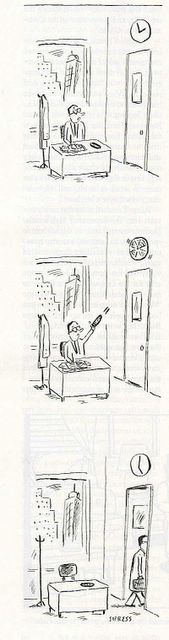
You ever had one of those days? (New Yorker-- June 5, 2006) Posted by Picasa

Thursday, June 01, 2006


The Chester Zoo in the United Kingdom recently celebrated the hatching of a pair of critically endagered Egyptian Tortoises. The baby tortoises are tiny, weighing only about 7 grams each and extremely cute! Posted by Picasa

Friday, May 26, 2006

I just got this from Arnie Witt, a friend of mine, via Symi. It's great!


US Presidential Position Outsourced to India


Congress today announced that the office of President of the United
States of America will be outsourced to India as of April 15th, 2006.

The move is being made to save the President's $400,000 yearly salary
and also a record $521 billion in deficit expenditures and related
overhead the office has incurred during the last 5 years.

"We believe this is a wise move financially. The cost savings should be
significant," stated Congressman Thomas Reynolds (R-WA). Reynolds, with
the aid of the Government Accounting Office, has studied outsourcing of
American jobs extensively. "We cannot expect to remain competitive on
the world stage with the current level of cash outlay," Reynolds noted.

Mr. Bush was informed by email this morning of his termination.
Preparations for the job move have been underway for sometime.

Gurvinder Singh of Indus Teleservices, Mumbai, India, will be assuming
the office of President as of April 15th, 2006. Mr. Singh was born in
the United States while his Indian parents were vacationing at Niagara
Falls, thus making him eligible for the position. He will receive a
salary of US $320 a month but with no health coverage or other benefits.

It is believed that Mr. Singh will be able to handle his job
responsibilities without a support staff. Due to the time difference
between the US and India, he will be working primarily at night, when
few offices of the US Government will be open. "Working nights will
allow me to keep my day job at the American Express call center," stated
Mr. Singh in an exclusive interview. "I am excited about this position.
I always hoped I would be president someday."

A Congressional spokesperson noted that while Mr. Singh may not be
fully aware of all the issues involved in the office of President, this
should not be a problem, because Bush was not familiar with the issues
either.

Thursday, May 25, 2006


If only... (from the New Yorker 052906) Posted by Picasa

Wednesday, May 24, 2006

This is an interesting article if only for the social commentary and criticism of the "self-help culture."

Dear Postindustrial Capitalism


from In These Times Magazine -- March 24, 2006
By Jessica Clark

Can I resign as the CEO of Brand Me, Inc? While profits and productivity are up, and product recognition is on the rise, the worker is complaining of long hours, tension headaches and job insecurity. Please advise.

Since early January, to the horror of my inner artist, slacker and cynic, my “inner executive” has been consulting a personal productivity advisor. David Allen, the mastermind behind Getting Things Done: The Art of Stress-Free Productivity, which recently hit No. 1 on the Business Week paperback bestseller list. Allen sports a tie and wire-rimmed glasses, and spouts a brand of management-speak that would set most lefties’ teeth on edge. Yet, his hippie past peeks through—Allen defines the goal of implementing his persnickety efficiency tactics as achieving a “mind like water.”

To help you reach that crystalline consciousness, GTD (as the book is known to acolytes) employs a bottom-up approach to dealing with all the junk that’s bugging you now—the crap on your desk, the nagging voices in your head, your closet clutter and your unrealized ambitions. Each of these unprocessed items, says Allen, represents an “open loop,” a commitment that your unconscious will hound you about until you record or reckon with it.

Once collected, this crud must be molded and sorted into categories: “trash” (the most satisfying), “reference” (sort of soothing) and “projects” broken down into “actionable items” sorted by “contexts” like home, office or phone. Allen then prompts devotees to review this project list—the backbone of the system—each week. Performed religiously, this routine transforms an adrenaline-fueled daily grind into a game of strategy that reformats dead time into do-time. By emptying your “psychic RAM” into this system, Allen argues, you free your mind for creative thought and arm yourself for rapid response to the changing exigencies of life.

With clients ranging from the U.S. Air Force to Lockheed Martin to the American Red Cross, Allen has hit it big in the business-consulting world. He’s also attracted a slew of less-conventional followers. The self-proclaimed “geek” world is enraptured by GTD; cult metaphors abound in the dozens of blogs, Wikis and software projects devoted to dissecting each phase of his method (check out http://del.icio.us/tag/gtd for a sampling). Wired writer Robert Andrews calls Getting Things Done, first published in 2001, a “holy book for the information age,” while blogger Anil Dash praises Allen for delivering an “aspirational digital lifestyle.” The GTD-infused word “lifehack” has become so popular that the editors of the New Oxford American Dictionary selected it as a runner-up for the 2005 Word of the Year.

Why has GTD generated such adulation? Merlin Mann, whose blog “43 Folders” has become a hub for the GTD community, provides some insight.

“Geeks are often disorganized or have a twisted skein of attention deficit disorders,” he writes. They also “crave actionable items and roll their eyes at ‘mission statements’ and lofty management patois,” and “have too many projects and lots and lots of stuff.” Sound familiar?

It should. In many ways, “geeks” are the canaries in the New Economy’s coalmine. Programmers and knowledge workers often operate as free agents in the digital economy—self-employed or contract workers with little job security and a constant need to reinvent themselves for new employers. Working at home or remotely, they are overwhelmed by a barrage of e-mails and media inputs, lack the structure and community provided by conventional offices, and must erect or erase hard boundaries between their personal and professional lives. Such a vacuum of external supports and structures means that such workers must find new systems for setting goals, defining next steps, and managing the “project” of life.

In 1950, sociologist David Reisman noted a major cultural shift in his influential book, The Lonely Crowd. He argues that over the years, Westerners’ social character has gone through three stages: the tradition-driven mode of the pre-modern era, the “inner-directed” style associated with industrialists and pioneers, and the mass-society “other-directedness” of the peer-driven consumer and office worker. GTD is a system that supports the emergence of yet a new character—what one might term the “self-directed” global creative.

Increasingly missed by social safety nets, unbound from traditional familial and cultural ties, atomized by free-market philosophies and awash in a sea of niche-defined consumer and lifestyle choices, the “self-directed” are wracked with anxiety. GTD supplants what Reisman described as the “gyroscope” of the inner-directed—an internalized set of values inculcated by society—with an inner index of individualized choices, projects and goals. This portfolio can then travel with you across jobs, cities, families, subcultures and life stages, absorbing anxiety along the way.

As Allen puts it, GTD trains your “inner committee”—providing “organization development from the inside out.”

Now, usually, at this point in a progressive critique of a business book, my inner satirist would be mocking Allen and his readers as bourgeois, work-obsessed drones lacking the requisite class consciousness to understand their plight. But such a critique is both facile and unimaginative.

The personal empowerment genre does present real dangers, as NYU sociologist Micki McGee points out in her recent book, Self-Help, Inc. “The capitalist demand is that one ‘be all one can be’: human capital, as with any other natural resource, is to be developed and exploited,” she writes. Yet, at the same time she continues, “The democratic demand—and promise—is that one will get to ‘be all one can be’: a human being reaching his or her greatest potential in association with others.” She goes on to note:

If one imagines self-help culture not only as a means of social control but also as a symptom of social unrest that has not found a political context, then, given the exponential growth of self-help reading, there is no shortage of unrest or dissatisfaction. Understood in these terms, self-help culture could potentially offer an enormous opportunity for cultivating social change.

It is this promise that attracts me to GTD, and to helpful and optimistic lifehackers like Mann and Ethan J. A. Schoonover, a freelance photographer and global gadabout who has come up with his own GTD twist at kinkless.com. While Allen’s system might read like a hybrid of soulless corporate disciplines like Total Quality Management and the deracinated Zen of stress-management retreats, it is surprisingly effective, and often fun. As a recent article in the Guardian notes, the initial “mind sweep” of projects “can be both traumatic and oddly liberating.”

These are tools not just for creating new ways to work, but for carving out time for leisure, action and reflection. As a self-proclaimed geek who straddles two increasingly volatile and insecure vocations—journalism and progressive politics—how can I resist? And then, there’s the lure: “mind like water.”

“Before GTD I used to have a really hard time getting to sleep,” says Schoonover. “My head would hit the pillow and my brain would start cycling through all these ideas. With GTD I do a much better job of capturing ideas as they come to me throughout the day. The improvement in sleep alone is worth the price of admission.”


Jessica Clark is the executive editor at In These Times.

Saturday, May 20, 2006

Incredible... for all of those who deny that Iraq is a boondoggle.....

U.S. Plan to Build Iraq Clinics Falters


Contractor Will Try to Finish 20 of 142 Sites


By Ellen Knickmeyer
Washington Post Foreign Service
Monday, April 3, 2006; A01


BAGHDAD -- A reconstruction contract for the building of 142 primary health centers across Iraq is running out of money, after two years and roughly $200 million, with no more than 20 clinics now expected to be completed, the U.S. Army Corps of Engineers says.

The contract, awarded to U.S. construction giant Parsons Inc. in the flush, early days of reconstruction in Iraq, was expected to lay the foundation of a modern health care system for the country, putting quality medical care within reach of all Iraqis.

Parsons, according to the Corps, will walk away from more than 120 clinics that on average are two-thirds finished. Auditors say the project serves as a warning for other U.S. reconstruction efforts due to be completed this year.

Brig. Gen. William McCoy, the Army Corps commander overseeing reconstruction in Iraq, said he still hoped to complete all 142 clinics as promised and was seeking emergency funds from the U.S. military and foreign donors. "I'm fairly confident," McCoy said.

Coming with little public warning, the 86 percent shortfall of completions dismayed the World Health Organization's representative for Iraq. "That's not good. That's shocking," Naeema al-Gasseer said by telephone from Cairo. "We're not sending the right message here. That's affecting people's expectations and people's trust, I must say."

By the end of 2006, the $18.4 billion that Washington has allocated for Iraq's reconstruction runs out. All remaining projects in the U.S. reconstruction program, including electricity, water, sewer, health care and the justice system, are due for completion. As a result, the next nine months are crunchtime for the easy-term contracts that were awarded to American contractors early on, before surging violence drove up security costs and idled workers.

Stuart Bowen, the top U.S. auditor for reconstruction, warned in a telephone interview from Washington that other reconstruction efforts may fall short like that of Parsons. "I've been consumed for a year with the fear we would run out of money to finish projects," said Bowen, the inspector general for reconstruction in Iraq.

The reconstruction campaign in Iraq is the largest such American undertaking since World War II. The rebuilding efforts have remained a point of pride for American troops and leaders as they struggle with an insurgency and now Shiite Muslim militias and escalating sectarian conflict.

The Corps of Engineers says the campaign so far has renovated or built 3,000 schools, upgraded 13 hospitals and created hundreds of border forts and police stations. Major projects this summer, the Corps says, should noticeably improve electricity and other basic services, which have fallen below prewar levels despite the billions of dollars that the United States already has expended toward reconstruction here.

Violence for which the United States failed to plan has consumed up to half the $18.4 billion through higher costs to guard project sites and workers and through direct shifts of billions of dollars to build Iraq's police and military.

In January, Bowen's office calculated the American reconstruction effort would be able to finish only 300 of 425 promised electricity projects and 49 of 136 water and sanitation projects.

U.S. authorities say they made a special effort to preserve the more than $700 million of work for Iraq's health care system, which had fallen into decay after two decades of war and international sanctions.

Doctors in Baghdad's hospitals still cite dirty water as one of the major killers of infants. The city's hospitals place medically troubled newborns two to an incubator, when incubators work at all.

Early in the occupation, U.S. officials mapped out the construction of 300 primary-care clinics, said Gasseer, the WHO official. In addition to spreading basic health care beyond the major cities into small towns, the clinics were meant to provide training for Iraq's medical professionals. "Overall, they were considered vital," she said.

In April 2004, the project was awarded to Parsons Inc. of Pasadena, Calif., a leading construction firm in domestic and international markets. McCoy, the Corps of Engineers commander, said Parsons has been awarded about $1 billion in reconstruction projects in Iraq.

Like much U.S. government work in 2003 and 2004, the contract was awarded on terms known as "cost-plus," Parsons said, meaning that the company could bill the government for its actual cost, rather than a cost agreed to at the start, and add a profit margin. The deal was also classified as "design-build," in which the contractor oversees the project from design to completion.

These terms, among the most generous possible for contractors, were meant to encourage companies to undertake projects in a dangerous environment and complete them quickly.

McCoy said Parsons subcontracted the clinics to four main Iraqi companies, which often hired local firms to do the actual construction, creating several tiers of overhead costs.

Starting in 2004, the need for security sent costs soaring. Insurgent attacks forced companies to organize mini-militias to guard employees and sites; work often was idled when sites were judged to be too dangerous. Western contractors often were reduced to monitoring work sites by photographs, Parsons officials said.

"Security degenerated from the beginning. The expectations on the part of Parsons and the U.S. government was we would have a very benign construction environment, like building a clinic in Falls Church," said Earnest Robbins, senior vice president for the international division of Parsons in Fairfax, Va. Difficulty choosing sites for the clinics also delayed work, Robbins said.

Faced with a growing insurgency, U.S. authorities in 2004 took funding away from many projects to put it into building up Iraqi security forces.

"During that period, very little actual project work, dirt-turning, was being done," Bowen said. At the same time, "we were paying large overhead for contractors to remain in-country." Overhead has consumed 40 percent to 50 percent of the clinic project's budget, McCoy said.

In 2005, plans were scaled back to build 142 primary clinics by December of that year, an extended deadline. By December, however, only four had been completed, reconstruction officials said. Two more were finished weeks later. With the money almost all gone, the Corps of Engineers and Parsons reached what both sides described as a negotiated settlement under which Parsons would try to finish 14 more clinics by early April and then leave the project.

The agreement stipulated that the contract was terminated by consensus, not for cause, the Corps and Parsons said.

Both said the Corps had wanted to cancel the contract outright, and McCoy rejected the reasons that Parsons put forward for the slow progress.

"In the time they completed 45 projects, I completed 500 projects," he said. Parsons has a number of other contracts in Baghdad, from oil-facility upgrades to border forts to prisons. "The fact is it is hard, but there are companies over here that are doing it."

Bowen called the outcome "a worst-case scenario. I think it's an anomaly." He said, however, that U.S. reconstruction overseers overwhelmingly have neglected to keep running track of the remaining costs of each project, leaving it unclear until the end whether the costs are equal to the budget.

"I can't say this isn't going to happen again, because we really haven't gotten a grasp" of the cost of finishing the many pending projects, Bowen said.


Correction to This Article
An April 3 article quoted Stuart Bowen, the top U.S. auditor for reconstruction in Iraq, as saying, "I've been consumed for a year with the fear we would run out of money to finish projects." Bowen actually said, "I've been concerned about cost-to-complete for a year, and the reason I've been concerned about cost-to-complete is the fear that we would run out of money to finish projects, and so I can't say that this isn't going to happen again because we never really did get a good grasp on cost-to-complete data."

Saturday, April 29, 2006

A release from the Eisenhower Memorial Commission:

UPDATE ON PROGRESS AT THE DWIGHT D. EISENHOWER MEMORIAL COMMISSION


The Eisenhower Memorial Commission has recently taken a big step toward creating a permanent national memorial to President Dwight D. Eisenhower.

Earlier this week, Congress passed Joint Resolution 28, a resolution granting permission to create an Eisenhower Memorial within the boundaries of "Area I." Area I is an area of Washington, DC reserved for memorials whose subjects are of pre-eminent historical and lasting significance.

On February 2, 2006, the Secretary of the Interior and the National Capital Memorial Advisory Commission recommended to Congress that the Eisenhower Memorial be allowed to locate within Area I. On April 4, 2006, the Senate passed by unanimous consent a resolution to approve the recommendation. On April 25, 2006, the House of Representatives unanimously approved this resolution by a vote of 411-0.

The effort to pass this legislation was completely bipartisan and was supported by the entire Kansas delegation, as well as a number of World War II veterans, including the Commission Chairman, Rocco Siciliano, the Commission Vice Chairman, Senator Daniel K. Inouye (D-HI), and the Commission's senior Republican, Senator Ted Stevens (R-AK).

The Commission selected a preferred site in June 2005 that is partially located in Area I. Now that Area I location is approved, the Commission can move forward with the site approval process, including presentations to the National Capital Planning Commission and the Commission of Fine Arts.

The Eisenhower Memorial Commission is very pleased with the swift passage of this measure and appreciates the work of everyone who made it happen.

Please share your thoughts and ideas on our continuing progress. Contact us by e-mail at info@eisenhowermemorial.org or call (202) 296-0004.

Sunday, April 23, 2006


 Posted by Picasa

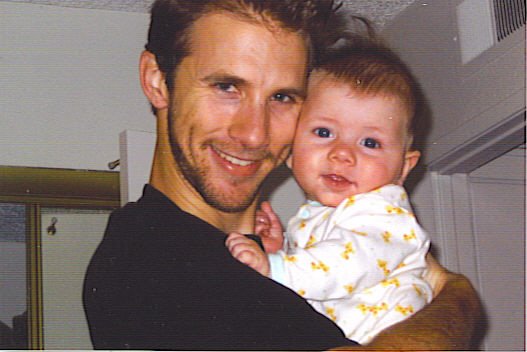
Two more photos of my adorable nephew-- the second one is with Daniel-- his father and my brother. It's not fair how photogenic he is! Posted by Picasa

Tuesday, April 11, 2006


Here's something that surprised me. Can you say cognitive dissonance? Posted by Picasa

Monday, April 10, 2006

I was listening to a very interesting Sherlock Holmes story-- "The Saviour of Cripplegate Square" of The Further Adventures of Sherlock Holmes written by Bert Coules (based on cases Holmes mentions in passing during the actual Conan Doyle mysteries)-- and heard some extremely interesting and useful quotations.

The following quotations are taken from an exchange between a young Sherlock Holmes and Mr. Nathaniel Collington Smith, a librarian in the British Library reading room, during a flashback in the story:

Smith: "Librarians don't read books, Mr. Holmes. They simply know about them.... "

......

Smith and Holmes are discussing a book that Smith alleges might be unsound in its reasoning.

Holmes: "Take it [the book] back."

Smith: "Why?"

Holmes: "I have no wish to clutter my mind with useless information."

Smith: "My dear Sir-- Your mind may not have elastic walls but it does at least have an entrance and an exit. Read the book. Decide for yourself what to retain. One can learn from the unsound as well as the sound, you know. Surely they taught you that at the university."

This last pearl of wisdom should be kept in mind more often in our modern lives.

Sunday, April 09, 2006


I thought this was worth posting too :-) Posted by Picasa

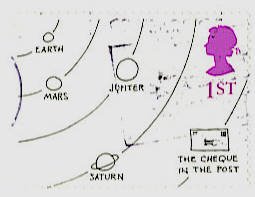
Sometimes I come across past American stamps featuring subjects that I imagine would never make it onto a stamp now. This is one of them. Posted by Picasa

Friday, March 31, 2006

Some of you may be following the recent unrest in France associated with proposed changes to French employment laws. Lots of the protestors are students, making universities epicenters of unrest. The Sorbonne came in for some particularly active protests and vandalism due to a security vacuum when the Sorbonne's security forces withdrew upon orders from the French police but they didn't move into the power vacuum themselves.

All is not horrible, though. A post to one of the listservs to which Symi subscribes (H-France) sheds a nice ray of humor into the generally unfortunate circumstances.

a number of students went up to the fourth-floor library (Chartes) to try
to prevent other occupants from throwing objects out of the windows,
and that fights broke out between those trying to protect the books and
those trying to throw things out the window. Throughout, there was a
third group, students trying to study in the stacks.

Saturday, March 25, 2006


Absolutely adorable! Posted by Picasa

But before I go, I couldn't help gushing over these photos of my nephew, Zachary. Isn't he cute!!! Posted by Picasa
Symi and I are going to be heading out early this morning to Austin, TX for the weekend (through Monday evening) to go to friends' wedding-- Erica Sager and Ken Pelman. Congratulations to the bride and groom! Mazel tov!

Knowing both of them and never having been to Austin, this'll surely be an adventure (or series thereof). Looking forward to it!

Tuesday, March 14, 2006

Here's some great cultural insight with a slight undercurrent of self-deprecation. The same format as Jeff Foxworthy's "You might be a Redneck" crossed with the responses Jay Leno gets in his 'Jaywalking' bits (for American audiences) but the circumstances talked about here are much less negative. If you have any connection to Russian culture or politics, you've got to read this! Inspired!

If you are Russian....

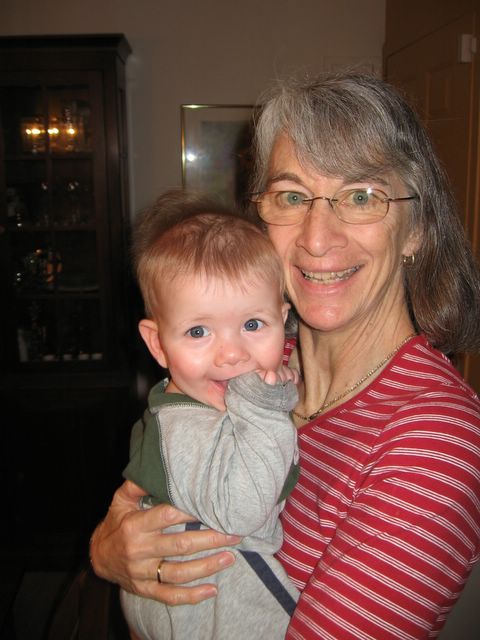
My little nephew Zachary and my mom, March 6, 2006. Isn't he cute!!! Posted by Picasa

Sunday, March 12, 2006

Here is a great article I saw in the March edition of The Hill Rag (from the Capitol Hill neighborhood of Washington, DC) written by a great guy who introduced me to my current boss. He's a very good guy-- and very funny!

The article is entitled "The Life of A Capitol Hill Rodent" describing his experiences with the titular animals. Read the whole article here.

Some of his final thoughts are as follows:

If you have a problem with mice, feel free to use these handy tips. I call them the 2006 Secrets of NIMH:
• Hill mice have an IQ higher than most Members of Congress, but less than most Supreme Court Justices – know where your intelligence falls on this scale.
• Hill mice are leaner and do not fit in standard traps. They have a group membership at one of the Hill gyms. Lobby to have their membership revoked.
• Hill mice prefer whole grains over processed ones. They were never after me Lucky Charms.
• Choosy mothers choose Jif, but Hill mice prefer Skippy extra chunky or any honey roasted peanut butter. Soy butter is not really enjoyed by anyone.
• As for a subscription to the Theory of Evolution or Intelligent Design - I do not know where they are published, so I cannot help you.

Wednesday, March 08, 2006

I saw an interesting article that discusses what the Daniel Yankelovich sees as a "great divide" between 'scientists' and 'society.'

While I don't necessarily agree completely with the points he raises solution he recommends, many of his observations are really thought-provoking in the larger context of society (not just with regards to science). Here is a short section from the article that I thought might raise some interesting questions in your minds. Any thoughts?

"Winning Greater Influence for Science"
by Daniel Yankelovich
Issues in Science and Technology
(published by the National Academy of Sciences)
Summer 2003


.....
The unfortunate reality is that scientists and the rest of society operate out of vastly different worldviews, especially in relation to assumptions about what constitutes knowledge and how to deal with it. Scientists share a worldview that presupposes rationality, lawfulness, and orderliness. They believe that answers to most empirical problems are ultimately obtainable if one poses the right questions and approaches them scientifically. They are comfortable with measurement and quantification, and they take the long view. They believe in sharing information, and their orientation is internationalist because they know that discoveries transcend borders.

The nonscientific world of everyday life in the United States marches to a different drummer. Public life is shot through and through with irrationality, discontinuity, and disorder. Decisionmakers rarely have the luxury of waiting for verifiable answers to their questions, and when they do, almost never go to the trouble and cost of developing them. Average Americans are uncomfortable with probabilities, especially in relation to risk assessment, and their time horizon is short. Policymakers are apprehensive about sharing information and are more at home with national interests than with internationalism. Most problems are experienced with an urgency and immediacy that make people impatient for answers; policymakers must deal with issues as they arise and not in terms of their accessibility to rational methods of solution.

This profound difference in worldview manifests itself in a many forms, some superficial, some moderately serious, and some that cry out for urgent attention. Here are three relatively superficial symptoms of the divide:

Semantic misunderstandings about the word "theory." To the public, calling something a "theory" means that it is not supported by tested, proven evidence. Whereas a scientist understands a theory to be a well-grounded explanation for a given phenomenon, the general public understands it as "just a theory," no more valid than any other opinion on the matter. (Evolutionary "theory" and creationist "theory" are, in this sense, both seen as untested and unproven "theories" and therefore enjoy equivalent troth value.)

Media insistence on presenting "both sides." When this confusion over "theory" bumps up against media imperatives, the result is often a distorting effort to tell "both sides" of the story. In practice, this means that even when there is overwhelming consensus in the scientific community (as in the case of global warming), experts all too often find themselves pitted in the media against some contrarian, crank, or shill who is on hand to provide "proper balance" (and verbal fireworks). The resulting arguments actively hinder people's ability to reach sound understanding: Not only do they muddy the public's already shaky grasp of scientific fundamentals, they leave people confused and disoriented.

Science's assumption that scientific illiteracy is the major obstacle. When faced with the gap between science and society, scientists assume that the solution is to make the public more science-literate--to do a better job at science education and so bring nonscientists around to a more scientific mindset. This assumption conveniently absolves science of the need to examine the way in which its own practices contribute to the gap and allows science to maintain its position of intellectual and moral superiority. In addition, on a purely practical level a superficial smattering of scientific knowledge might cause more problems than it solves. Two other manifestations of the divide are less superficial and more serious:

The craving for certainty about risk and threat. The public and policymakers crave a level of certainty that the language and metrics of science cannot provide. For example, when the public is alarmed by something like the anthrax scare or some future act of small-scale biological or chemical terrorism, science will assess the threat in the language of probabilities. But this metric neither, reassures the public nor permits it to make realistic comparisons to other threats, such as nuclear terrorism. Science's frame of reference does not communicate well to the public.

Divergent timetables. The timetables of science (which operates in a framework of decades or longer) are completely out of synch with the timetables of public policy (which operates in a framework of months and years). It has taken nearly 30 years for the National Academy of Sciences to complete its study of the consequences of oil drilling in Alaska's North Slope; in that time, a great deal of environmental damage has been done, and political pressure for further exploration in the Arctic National Wildlife Refuge has gained momentum. At this stage, the academy's scientific report stands to become little more than a political football. Vaccine research is another example: Political demands for prompt action on high-profile diseases do not jibe well with the painstaking process of research and trial. Political pressures push resources toward popular or expedient solutions, not necessarily those with the greatest chance for long-term success.

Two more manifestations of the divide are particularly troublesome:

The accelerating requirement that knowledge be "scientific." In both the academic community and Congress, the assumption is growing that only knowledge verified by scientific means (such as random assignment experiments) can be considered "real knowledge." Unfortunately, only a minuscule number of policy decisions can ever hope to be based on verified scientific knowledge. Most public policy decisions must rely on ways of knowing--including judgment, insight, experience, history, scholarship, and analogies--that do not meet the gold standard of scientific verification. Our society lacks a clear understanding of the strengths and limitations of nonscientific ways of knowing, how to discriminate among them, and how they are best used in conjunction with scientific knowledge. Since the time of the ancient Greeks, our civilization has presupposed a hierarchy of knowledge, but never before have forms of nonscientific knowledge been so problematic and devalued, even though they remain the mainstay of policy and of everyday life.

Colliding political and scientific realities. Although the scientific framework demands that scientists maintain objectivity and neutrality, political leaders pressure scientists to produce the "correct" answers from a political point of view. When political and scientific imperatives collide, science is usually the loser. President Reagan's science advisors on antiballistic missile systems found themselves marginalized when they didn't produce the answers the administration wanted. Scientists do not have a lot of experience in dealing with political pressures in a way that permits them to maintain both their integrity and their influence. Arguably, this has been the greatest single factor in science's declining influence in policy decisions.

Nor are these the only symptoms. A host of other elements exacerbate the divide between the two worlds: unresolved collisions with religious beliefs, difficulty in assessing the relative importance of threats, the growing number and complexity of issues, and the wide array of cultural and political differences in society.
.....

Friday, March 03, 2006

Whoever said that history is dull?

Read about the Great Molasses Flood of 1919

Thursday, February 16, 2006

This came out in The New York Times a year or two ago but it's amazing how true it still is....


Decoding the Bureau


by Andy Borowitz


From: Director, CIA
To: All CIA Employees

In the weeks and months ahead, some of you may find yourselves talking to FBI employees for the first time. To prevent possible errors in communication, here is a guide to common FBI phrases, complete with their English-language translations:

FBI: We have noticed "increased chatter" in recent weeks.
Translation: We've been intercepting conversations that could be useful if someone here knew Arabic.

FBI: We are making technological improvements at headquarters.
Translation: We now have call-waiting.

FBI: We are committed to making real changes in the way we conduct our business.
Translation: Ever since Coleen Rowley started singing to Congress, we've actually had to read the junk we used to leave in our In-Boxes.

FBI: Here is a list of suspects for you to track.
Translation: This ought to keep you busy while we look for the suspects on the real list, which is safe in our files.

FBI: I am studying the document you shared with me.
Translation: I've been trying to open your e-mail attachment for two days. Are you guys on PCs or MACs?

FBI: We both have the same goal.
Translation: If we put our heads together, I'll bet we can shift the blame to the Bureau of Labor Statistics and the National Park Service.

FBI: Please get back to me at your earliest convenience.
Translation: There is an excellent chance that you or I will be forced to resign by the end of the day.

FBI: Please share this document on a need-to-know basis only.
Translation: If you leak this one to Time, we'll leak the next one to Newsweek.


You can see more of this kind of thing at Andy Borowitz's website-- The Borowitz Report.


The sad thing about this is that it continues to represent current concerns and would still would work pretty well even if you switched the organizations' names around.

Sunday, February 12, 2006

I was up on Capitol Hill the other day and had a good chuckle at something I saw as I was walking by Dennis Kucinich's office and saw a big framed poster saying the following:

Civilization:
1. Polka
2. Bowling
3. Kielbasa


I'm not sure I'd want this guy as president, but you got to admit that he's got a sense of humor....

Wednesday, February 08, 2006

This is a very good article-- saying things that I've not heard before in the popular press:

Saving the Post Office
As Mail Usage Drops, USPS Faces a Whirlwind of Change


By Margaret Webb Pressler
Washington Post Staff Writer
Sunday, January 15, 2006; F01


There are, in many ways, two U.S. Postal Services.

There is the one that people love to hate, especially after a hike in rates such as last week's two-penny jump. This is the Postal Service that made Mark Tornga, 24, hold his head in disbelief as he walked out of a post office on 14th Street NW at 4:30 one afternoon last week.

"Fifty-two minutes I spent in line -- 52 minutes!" the College Park resident fulminated after sending a certified letter for his employer, a public relations firm.

Then there is the Postal Service that has made huge strides in on-time delivery, runs one of the most impressively automated operations in the world and, for now, is bringing in a huge profit. This is the Postal Service that customers such as Tornga don't see, and, frankly, take for granted -- the one that moves 580 million pieces of mail a day with remarkable speed and accuracy to every address in the nation, six days a week.

The first Postal Service is the one that executives are trying to fix, the one with the bad rap, the one that delivers mail late, the one that drives people crazy with its long lines and sold-out 2-cent stamps.

The other Postal Service is the one they are trying to save.

"Am I optimistic or pessimistic? I'd have to say I'm anxious," said John M. Nolan, who retired last year as deputy postmaster general and now works as a consultant.

The structural problems facing the Postal Service are monumental. Despite a tiny uptick last year, first-class mail volume is slowly but steadily eroding as people pay more bills online, send Evites instead of printed invitations and shoot off e-mails rather than write letters. The agency also is facing massive and escalating personnel costs, especially for health care, even as it has embraced automation and reduced staffing needs. And finally, there is the federal government's attempt to change the structure of Postal Service regulation, an effort that postal officials regard as riddled with problems and with favors to private industry.

"It doesn't give us nearly the flexibility we believe we need," said Tom Day, senior vice president of government relations for the Postal Service.

Without making some hard decisions -- and revisions -- in the near term, Nolan and others say, the Postal Service "is on a crash course with cataclysmic change."

What kind of change and when is unclear. Privatization? Shuttered post offices? Dramatically more expensive mail? Less frequent delivery? It could be any of those things -- or none of them. It just depends on how things go.

And this is when people start thinking about the third Postal Service -- the one that delivers possibility six days a week -- a letter from an old friend, a tax refund or an acceptance from the admissions office. This is the post office that brings us the letter carriers we admire, who avoid dogs and leave footprints in pristine snow. It gives the tiniest towns their own proud postmarks. It's the post office that found you even when the address under your name was so incredibly incorrect it was laughable.

This is the Postal Service that no one wants to lose.

* * *

At its most basic level, the Postal Service needs to keep as many customers as it can, and a good place to start is by tackling its legendary customer-service problems. Although users of many rural and suburban post offices rarely see the kinds of hassles that are routine in urban locations, city dwellers are familiar with the maddening pace of two clerks plodding through a 20-person line.

At these especially busy locations, Day said the agency is trying to keep wait times down by rescheduling staff lunch breaks, once routinely taken during the midday rush, and splitting some shifts in two. Individual postmasters are tracked based on such performance criteria, too, with independently measured wait times at individual offices factored into pay and promotions at the end of every year.

"Unfortunately, we know, looking at the numbers, we do have pockets of problems," Day said. "But the good news is we're aware of it; we do hold people accountable. That's where we really force the issue of restaffing and rescheduling."

With 38,000 retail offices nationwide, this effort is notoriously slow going. That's how, even on the Monday before Christmas -- a day touted in a Postal Service press release as the busiest mail day of the year -- there were only two clerks serving customers at 6 p.m. at one of the District's main post offices, the Friendship branch in Northwest. The line snaked out the door.

Day said that in such circumstances, the branch manager should be out in the lobby, sorting customers' needs in line and helping where possible. On the other hand, managers inclined to do this are somewhat limited in how they can pitch in because, under union rules, they cannot open an empty clerk station and start serving customers.

William Burrus, president of the American Postal Workers Union, said the Postal Service has institutionalized long wait times by cutting staff sizes, following the model of the private-sector retail industry.

"They could provide a two-minute wait max, if they wanted to," Burrus said. "But they don't want to because they know the American public will accept a delay. They've become accustomed to it."

One area where Day and Burrus agree is in the way Americans view postal employees. Surveys show that most of them hold postal workers in high regard. Even Tornga, after his 52-minute wait in line, offered up an unprompted compliment.

"Once you get up there, the people are perfectly nice," he said. "It's just crazy how long it takes."

* * *

In the meantime, postal officials keep coming up with ways to keep people -- happily -- out of the post office.

There are the post office's retail partners, grocers in particular, that sell books of stamps, which has become one of the most common ways people buy stamps.

(Day bristles at the thought that the post office seems to get no credit for such efforts. "It's as though supermarkets dreamed it up all on their own," he said.)

There's the almost-four-year-old Click-N-Ship service: Go online and find out the rates, print the postage at home, then schedule a free pickup.

The problem has been getting out the word that Click-N-Ship even exists, in a world where many small-volume mailers now reflexively call United Parcel Service or FedEx. Day says even his own nephew was using UPS to ship things he sells on eBay.

"There is, in the younger generation, a sense that the Postal Service is out of date, slow and all the rest," he said. "So reaching them and letting them know that we do provide online services that are useful, customer friendly and timely is a challenge."

Computer-generation technology has also reached 2,000 postal offices nationwide in the form of new Automated Postal Centers, which can do many of the things people stand in line for: dispense stamp sheets, sell postage in any denomination, look up rates and Zip codes, provide certified mail receipts, and so on.

"I'm sure my mother would struggle with it, but people who are comfortable with computer technology, after just a few basic tips, they understand how to use it," Day said.

And for the lower-tech among its customers, post offices now give out nifty cardboard scales that measure how much postage you need for a letter.

* * *

To encourage people to use the mail more, the post office has been aggressively advertising some of its newer services on television. It is even getting downright touchy-feely. In another effort borrowed from Madison Avenue, it's giving people what they love: babies and animals.

The Postal Service is in the midst of a second test of PhotoStamps, which let consumers put their own cute pictures on commemorative-size stamps they can order online. It was the brainchild of Stamps.com, which has long had a contract with the Post Office to sell postage online.

"To their credit, they went along with it," said company president and chief executive Ken McBride, who deems the test a success. From May to September, customers bought 3.5 million PhotoStamps, he said, featuring adorable kids, bouncy puppies and romantic moments.

"We believe a lot of this is new revenue," McBride said. "Customers are using PhotoStamps and coming back from electronic means of communication. They're excited about it, so they're sending real invitations rather than electronic invitations, personal letters instead of e-mail."

* * *

Behind the scenes at the Postal Service lie both its best and worst stories.

Since 2000, the agency has gone through an astonishing makeover of automation and efficiency; reducing staffing by 100,000 to just over 700,000, all through attrition; while delivering more mail to more delivery points. Last year, the post office took roughly 212 billion pieces of mail to 144 million addresses, 2 million more delivery points than in 2004.

What postal officials find most gratifying is that on-time delivery has improved, too: Today, 96 percent of mail is delivered on time to the Zip codes that should only take only one day for delivery. Eight years ago, that figure was 92 percent, Day said.

Businesses and other big-volume mailers are bar-coding mail so it can be processed faster and automatically. New optical readers can decipher all but the worst handwriting on envelopes.

And last year was a particularly good year, with mail volume up, and even first-class mail rising one-tenth of a percent. But these results belie an underlying erosion in the most important type of the Postal Service's business.

About two years ago, first-class mail fell below the 50 percent threshold of mail volume for the first time. It now accounts for about 46 percent of all mail, while direct-mail marketing items represent 49 percent. The rest is packages. The package-delivery business is so dominated by UPS and FedEx that the Postal Service now partners with these private carriers along parts of the delivery chain. The theory is that it's cost-effective for both if only one delivery person has to walk up to a house. There are even FedEx boxes in some post offices.

The decline in first-class mail is partly because people are writing fewer letters, but it's also closely tied to the banking industry. The more people pay bills online, the more money banks save, so they're making it easier to do. Financial remittances represent about $17 billion of the Postal Service's $70 billion operating revenue, so it's a big chunk to lose.

"My concern would be . . . there comes a tipping point in the financial services industry where the balance goes so heavily towards electronic means of communication for bills and bill payment that they may get more aggressive in providing incentives to customers to get them out of the mail," Day said.

To deal with the expected decline in revenue, the Postal Service needs to raise money in other ways and cut costs, and that means several looming battles, Day said. Rates will likely rise again for first-class stamps and for direct mail, perhaps as early as next year, he said.

Later this year, the agency will also begin renegotiating contracts with four major unions in hope of winning concessions on some high-cost benefits such as health care. Union leaders are ready for a fierce fight.

"The employees that I represent, they should be rewarded for a job well done," Burrus said. "All of the savings [the Postal Service has] achieved came on the backs of the employees I represent."

And the Postal Service faces an even bigger battle with Congress, which is considering reforms that would change some of the service's legal requirements and create a new oversight body. But critics of the legislation are everywhere, and bills in the House and Senate are stalled.

"Everyone who wants something to be done throws in their oar at the 11th hour," said Nolan, the former deputy postmaster general, leaving the bills full of favors to private industry and regulations that will hamstring postal officials. "If you wanted to design bad legislation, this is it."

But there are critics of the Postal Service who like the idea of more regulation, if only because it would create more accountability for its failures.

"There is realistically no one that can force the Postal Service to do anything," said Rick Merritt, executive director of PostalWatch, a nonprofit watchdog group. "The Postal Service does not get appropriations from Congress, so one huge lever in the typical governmental oversight is not there."

For all the dire predictions mail-industry experts make about the Postal Service, though, there remains an underlying feeling that somehow it will get worked out. It's like this: You just can't let the post office -- the one we feel so connected to -- go away.

"Because there's such power in mail,' " Nolan said, "I have to believe that people looking at it intelligently will find the right answer before it's too late."

Friday, February 03, 2006

I'll be in Nashville with Symi over the weekend, visiting her dad. Never really been to the South and I'm curious to see what it's like....

Be back on Sunday!

Monday, January 30, 2006

People who hysterically fear that some such organization as the United Nations is going to take over the United States and control its internal affairs ares some of the best creators of bogey men that I have yet encountered.

-- Dwight D. Eisenhower
in a letter to his brother, Edgar,
January 12, 1954

Sunday, January 29, 2006


This is a great photo! I thought it really deserved to be published somewhere....  Posted by Picasa

If only it were that simple.... Posted by Picasa
January is grad school application month-- and it will likely overflow into February and maybe even later....

Anyone out there know any university presidents or other influential people that could get me in without all this hassle?

Sunday, December 25, 2005

HAPPY HOLIDAYS!!!!


I'm in California for the Holidays and waiting for Symi to come and join me under the starry sky, framed with palm trees and the Chocolate Mountains.

I hope everyone is doing well! And for those of you who celebrate Christmas, I think you'll really enjoy this link:

NORAD Tracks Santa Claus

Tuesday, December 13, 2005

"If all that Americans want is security, they can go to prison."
-Dwight D. Eisenhower

Friday, December 02, 2005

I've been doing a lot of traveling and a lot of work recently so why not a link that combines both of these?

Betty in the Sky with a Suitcase really good site-- one (start hick accent) of these newfangled podcasts (end hick accent). There are some amazing stories-- especially the one of her experiencing the Northridge earthquake, a hijacking to Cuba, and lots more. Don't be put off by her kind of strange manner and kind of strange music. Betty is definitely worth listening to.

Books for America


I hadn't realized that these people had set up a physical presence beyond filling up the ballroom of the Raddison Hotel every three months ago. Now they seem to have an actual storefront at 1417 22nd Street, NW here in Washington, DC near the corner of 22nd & P in Dupont.

Check these people out if you haven't already. They have lots of great books and it's for a really great cause!

Tuesday, November 15, 2005

This is an article profiling someone I've been working with quite extensively while at the Eisenhower Commission. Why do such terrible things happen to such good people?

He Writes, Travels while Raising 2 Little Girls


by Bill Atkinson
September 2, 2005
The Baltimore Sun


LOU GALAMBOS has written or edited more than 20 books. He was editor or co-editor of 16 volumes of The Papers of Dwight David Eisenhower - a labor of love that took him 29 years to complete. He is recognized as one of the nation's top business historians. He even keeps Post-it Notes by his bedside in case he wakes up in the middle of the night with an idea.

Yet, for all of his accomplishments, the Johns Hopkins University professor sees his biggest challenge now, in raising his kids. At 74, he is a single father of two girls, 7 and 6, and they can run him ragged.

"I usually have given it all by the end of the week," Galambos said. "It is trying to think about what you are doing on a manuscript that day and also to remember to buy milk."

Three years ago, Galambos' wife, Jane Sewell, a former Johns Hopkins lecturer who co-authored a book with him, was struck and killed by a truck while crossing a street in Santa Fe, N.M., where the two were on vacation.

"She was only 42," he said over lunch at the Hopkins Club. "It was a horrible, terrible kind of accident. It was such a stunning thing to lose somebody."

He pauses to gather himself before recalling what it was like to come home and tell the children.

"That still breaks me up," he said. "You don't want to ever do that. I had to help my daughters right away. You don't sit around and grieve, you get busy. You have one day, maybe two days [to grieve], you have got a new life to deal with."

At an age most men are retired, puttering around the house and set in their ways, Galambos was forced to change.

Instead of getting up at 5 a.m. and writing, he now rolls out of bed at 5:45 a.m., gets ready for work, slugs down tea and coffee for the "caffeine jolt," and has the girls ready for school by 7:30 a.m. During the school year, he gets home around 5 p.m. and fixes dinner.

He has cut back travel, doesn't attend as many conferences as he used to and, if he has a speech in another city, he delivers it and catches the next flight home. When he travels overseas he takes his daughters, Katherine, 7, and Emma, 6, with him. They've been to Florence and Milan, Italy, and London.

Galambos has a nanny, a backup nanny and an extensive support system, which include his two older daughters from his first marriage. They have moved to the area to help out.

His oldest daughter, Denise Galambos, an attorney at Constellation Energy, sits down with him each Sunday night after dinner and maps out the week's schedule at the dining room table.

"It is never uncomplicated," said Jennifer Galambos, who moved to Rockville a year ago from Connecticut to help. "He is remarkably organized."

Denise Galambos has a 6-year-old daughter, Haley, who is in the same grade at Friends School with Emma. [Katherine attends the school, too.] She shares a nanny with her father, who combs the girls' hair and lays out their clothes for the next day.

"I have to keep a schedule as to where the girls are at all times," Lou Galambos said. "If I don't keep it written down I get lost."

Last year, he forgot to pick up Katherine at yoga after school.

"That was one of the days I dropped the ball," he said.

There are soccer games to attend, ballet practices, swimming meets, T-ball games and birthday parties.

"You have to be able to shift gears suddenly, stop thinking about the third industrial revolution and start thinking about a birthday you have to go to for that little girl," he said. "You are going to an endless round of birthday parties."

Each night he reads to his girls, helps them with their homework, watches Sponge Bob with them and knows almost all the words to Kidz Bop 7. He is teaching both kids to play squash and he has one rule: "No whining."

Yet, he is driven at work.

"He has still got quite a bit of spring, a rather high output kind of guy," said Steve Hanke, professor of applied economics at Hopkins who co-runs the Institute for Applied Economics and the Study of Business Enterprise with Galambos.

Hanke, who worked last weekend, saw Galambos in the office Saturday night and on Sunday "grinding away."

"He is just very disciplined and organized. In his case it is long hours and high output," Hanke said.

How disciplined? About two years after Galambos' wife died, he finished a book about Roy Vagelos, the son of Greek immigrants who became CEO of Merck & Co., the big drugmaker. Galambos dedicated the book to Jane Sewell.

"I had Roy involved, I felt very responsible to him," Galambos said. "You have to keep going in life."

Galambos has another book in the works and expects to complete it next year. Then, he's got eight or nine other ideas in mind, including an op-ed piece on Carly Fiorina, the ousted CEO of Hewlett-Packard.

"This is the only society in the world in which a woman could have that high of a position in a high-tech business firm. She broke the glass ceiling," he said.

But at home pressure is mounting. The girls want their father to buy them Floam, a gooey, fluorescent substance that sticks to anything and can be molded into different shapes.

"I have been under this pressure for a week," Galambos said. "They have put the [1-800] number out on the kitchen table so I can call."

They're also trying to soften him up so he'll get them a dog.

"I said we will get a dog when I retire," Galambos said. "I have no thought of retiring."

Friday, November 04, 2005

Parliamentary elections are scheduled over the weekend in Azerbaijan-- this is a very important case for many reasons, especially given its proximity to major areas of interest (Russia, Iraq, Iran, etc.) and the wave of 'revolutions' sweeping through the republics of the former Soviet Union (Ukraine's Orange Revolution, Georgia's Rose Revolution and Tajikistan's Tulip Revolution). The Baku-Ceyhan oil pipeline has only made Azerbaijan more important on the petroleum front-- setting the stakes even higher for the West (especially the United States).

We'll see what happens.
A little-noticed step in the right direction deserves kudos:

VATICAN: FAITHFUL SHOULD LISTEN TO SCIENCE

VATICAN CITY - A Vatican cardinal said Thursday the faithful should listen to what secular modern science has to offer, warning that religion risks turning into "fundamentalism" if it ignores scientific reason.

Click here to read more

Monday, October 31, 2005

Symi and I had a great time hosting a Halloween/Housewarming party on Saturday! I'll be posting more things as soon as we get the photos arranged.

Glad to see all of you who were able to show up!

Wednesday, October 26, 2005

I leave it up to you, the readers, to decide how closely

this ("Stop the Bop" to Raise Katrina $$)

is related

to this (the definition of extortion).

Monday, October 24, 2005

Happy UN Day!!


60 years ago today, the United Nations officially came into being. Since then, few, if any, entities in the world have come close to making the positive impact the UN has. It has saved the lives of countless people through its direct actions in peacekeeping, development, and disaster relief in addition to the many, many other lives saved and bettered through work in world health, environment, education, and political reforms. For a more detailed list, click here.(pdf)

Also, visit the UN's 60th Anniversary webpage here.

Saturday, October 15, 2005

This is a very interesting website:

Birobidzhan: Stalin's Forgotten Zion

Friday, October 14, 2005

Here's a good article with lots of good background on the recent attacks in Nal'chik, Russia:

Religious Extremism Finds Fertile Ground
from The Moscow Times by Simon Saradzhyan (staff writer)
October 14, 2005 (Friday)
I've been doing lots of things that deserve blog space but the act of doing them has kept me from doing so. I'll fill you in soon.

Tuesday, October 11, 2005

Oops!


Government Can't Explain Increase in 2002 TSA Contract: Homeland Security Office Says It Lacks Documentation on $343 Million Change
Article by Scott Higham and Robert O'Harrow, Jr.
The Washington Post Sunday October 9, 2005

Wednesday, September 21, 2005

In defeat—unbeatable.
In victory—unbearable.


- Winston Churchill
describing Field Marshal Montgomery

Monday, September 19, 2005

Friday, September 16, 2005

One of the people who should be revered for the amazing strides they've made, but will continue to live their lives in obscurity:

'Anybody, Somebody, Anybody, Nobody'

Tuesday, September 13, 2005

If ignorance is bliss, why are so many people so unhappy?

Thursday, September 08, 2005

A quick note--

I'll be in Chicago from this afternoon to next Monday afternoon-- anyone needing to reach me should call my cell phone. I won't be able to check email.

Thanks.
Here's an interesting human-scale view of Azerbaijan:

Frontierland: Azerbaijan has a rich multi-ethnic history, decrepit Soviet-Era achitecture, great food, and enormous quantities of oil. Gary Shteyngart takes in the surreal contrasts of the wild east.

From www.travelandleisure.com on September 2005.

Monday, September 05, 2005


This is a cute piece of marketing I picked up at the APSA conference from the Princeton University Press booth. It's the front of a button to promote their publication of "On Bullshit," a book by Harry G. Frankfurt. Posted by Picasa

Thursday, September 01, 2005

The American Political Science Association (APSA) is having their 101st Annual Meeting & Exhibition mercifully close in DC this week, so I'm running around trying to soak up what I can. It's really hard to make decisions about what sessions to go to since over 30 sessions are often scheduled for the same time.

There's also this neat option of the website for people to post drafts of the papers they will be presenting.

XADS President Pete Bitar demonstrates his "Dazzler" laser. He also made an impression with his "StunStrike" lightning gun that shoots 4-foot bolts of lightning. (Photo by Chris Hartlove for the Washington Post in the article below.) Posted by Picasa
This is a really interesting article on many levels:

Xtreme Defense

One, the degree to which the Pentagon is supporting non-lethal weaponry. So much for shock and awe-- but while the money is more than zero, it still isn't very substantial.

Two, the discussion of the intersection of culture and military hardware. The bizarre idea of the 'voice of god' is directly referenced but the difference between the marketing and country fair atmosphere of the non-lethal weapon trade expo and the rather severe image conjured up by the name "Quantico."

Three, how deeply in the article you have to read before one of the main topics is revealed (the non-lethal weapons expo). You could have read half of the article and thought it only discussed Pete Bitar and the projects of his company XADS. Don't know if that's a bad thing-- reward those who read farther (and therefore have an attention-span longer than a TV commercial) or maybe WashPost losing a big chunk of its readership....

Four, how Nikola Tesla keeps popping up in strange places.

Five, how important many obscure events as inspiration for big ideas (like Bitar's work in a styrofoam recycling plant) get short shrift.

Six, Bitar's comments about selling to non-American militaries.

There are more levels but I'll give y'all a rest...

HAPPY BIRTHDAY SYMI!!!

Tuesday, August 30, 2005

Though I don't know anyone in Katrina's path, my thoughts are with those of you out there less lucky than I am.

There has been a lot of news attention given to the evacuation of New Orleans and brightly (false-)colored but realize also that it's shut down a huge chunk of US oil refining capacity-- nearly one-fifth of all American refining capacity is in the state of Louisiana alone. Get ready for that to put a little bit more loft into oil prices.

Sunday, August 28, 2005

Got back from a bit of vacation (back home) in California a few days ago and, whew(!), lots of changes and things to talk about-- both there and here, in DC. Too much to sit and write out in one block since I need to be up and into work early tomorrow morning since several VIPs are going to be there for the beginning of the week.

One of the biggest pieces of news is that Symi and I are moving into a very nice new apartment. Whee! :-)

Friday, August 12, 2005

Hey-- if anyone out there knows of a nice, bright one-bedroom apartment near a DC metro station, let me know. Symi and I are looking for a good place to move in together and just had a nice place slip maddeningly through our fingers, so we're back at square one.

Thanks.
This is a cool thing-- well designed for what it does. And nice graphics!

Check out this 3-D real-time model of the orbits for the European Space Agency's Earth Observation satellites.

Monday, August 08, 2005

While working on a big database for work, I came across a couple of truly bizarre towns in the United States. I am not making these up:

Soddy Daisy, TN

Fuquay Varina, NC
A guy in London has declared his one-bedroom apartment an independent country.

Saturday, August 06, 2005

"I cannot support a war without international agreement or domestic support."


This is a sad day.

The former British Foreign Minister and Leader of the House of Commons Robin Cook collapsed today while hill walking (hiking) in North Scotland. He was pronounced dead upon reaching Raigmore Hospital in Inverness.

Robin Cook had an amazing career in British politics but is especially known for resigning his key leadership position in the British Labo(u)r government in March 2003 to protest against the war in Iraq.

Read Robin Cook's BBC obituary: Former Minister Robin Cook Dies

Read more of Robin Cook's resignation speech (March 2003)

Monday, August 01, 2005


This is self-explanatory (The New Yorker July 25, 2005) Posted by Picasa

Sunday, July 31, 2005

This is a very interesting article, though there are several things to take under advisement. First, this guy's first language is definitely not English and second, realize that burying airplanes is very different than burying WMDs...


A U.S. military search team examines a Cold War-era MiG-25R Foxbat B, the fastest combat aircraft today(*), that lay buried beneath the sands in Iraq. Several MiG-25s and Su-25 ground attack jets have been found buried at al-Taqqadum air field west of Baghdad.

Side-view of the Iraqi MiG-25RB (actually Soviet-controlled-- read the article)


By the way, Al-Taqqadum air field has been taken over by the US Army and they changed its name to (FOB) Camp Ridgeway from October 2003 to March 25, 2004, when it was renamed Camp Taqqadum since the US was desperate for political reasons to put an "Iraq face" on their presence.

* That the MiG-25RB is "the fastest combat aircraft today" is a lot more overblown than it might make you believe. First, reaching its top speeds would necessarily destroy the engines (making it a very expensive sprint). Second, even below its top speed, it was comparably difficult to maneuver, making it vulnerable to surface-to-air missile technology developed in the mid-1970s. Additionally, lots of other Soviet and other countries' aircraft were built for tasks other than combat that went faster than that. See this page for more details.